The Alphabet Enigma

Ask a British person how many letters there are in the alphabet and they will instantly answer: twenty-six.

Ask a Polish person how many letters are in the Polish alphabet and they don’t know. Indeed, they don’t even care. The most typical responses are:

  • who cares?
  • never counted!
  • why would I need to know that?

In Britain everybody knows some basic facts – there’s 1 sun in the sky, 4 points on a compass, 12 months in a year, and the first thing you learn on your first day at school is that there are 26 letters in the alphabet.

In Poland, no seems to give a damn how many letters there are.

It’s weird, shocking, even scandalous, and whenever I express this to a Pole, they don’t see the problem.

Without knowing how many letters are in the language, how can you type an email, decode the enigma machine or do something really hard, like play Scrabble?

I guess part of my shock is connected with the fact that I, as a foreigner learning Polish, had to get to grips with many additional letters. Yet Poles don’t even know how many there are!

Another enigma that surrounds the Polish alphabet are the phantom letters Q, V and X. They’re not in the language, but they show up from time to time and this confuses me.

V, for instance, isn’t in the written language, but does exist in body language – I’ve seen many Poles holding up two fingers to show the V for victory gesture. Is this allowed? V isn’t even in the Polish alphabet. Shouldn’t they make a Z for zwycięstwo gesture by drawing a Z in the air… or would people think they’re referring to Zorro?

Then, there’s X which appears in the names of countless Polish firms from Budimex to Metalex, while Q is present in Latin words such as Quo Vadis. So do the letters Q, V and X exist, or don’t they?

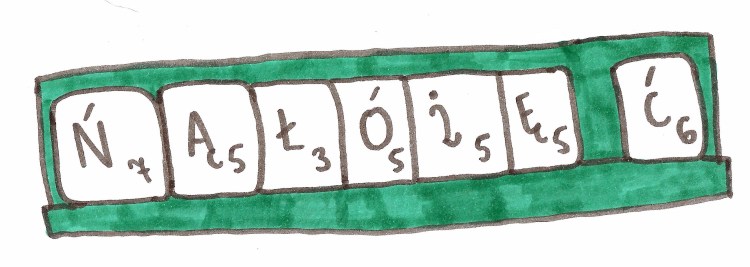
Foolishly, I once agreed to play Scrabble in Polish. An English native-speaker gets a surprise straight out of the box when you see the points on the letter tiles. In the English version, Z is worth 10 points while in the Polish version it’s only worth 1. The other most valuable letter in English is Q, which is worth 10, but isn’t in the Polish version. My usual strategy for winning – waiting until I can place the word q-u-i-z on a triple word score – just wasn’t going to work.
scrabble

So I started with a short, simple word – just three letters J, U and Z to spell the Polish word for ‘soon‘:

Me: It’s on a triple word score, so 3 times 6 equals 18 points.

Opponent: There’s no such word, już is spelt with a Ż.

Me: Aren’t the Z’s interchangeable? I don’t have a Z with a dot.

Opponent: No, they’re completely different letters. One is worth 1 point while the other is worth 5.

Me: Oh come on. That’s pedantic. It’s the same letter. Looks the same, sounds the same and comes at the end of the alphabet.

Opponent: No, Z, Ż and Ź are different letters entirely.

Me: But I’m a foreigner, isn’t there’s some handicap system in which I can substitute a normal Z, S or C for the funny ones?

Opponent: No. They’re different letters. You can’t substitute a M for a W by turning it upside down!

Me: Fine, can I have ‘F-U-J?

Opponent: No, it’s not a word.

Me: Of course it is. That’s what foreigners say when they first see the Polish alphabet!

Okay I was being facetious – they look so cute that learners, when they first encounter the new letters, give them special names:

  • funny E
  • Z with a hat
  • A with a tail
  • L with a belt

I guess it’s because they look like Roman letters dressed up in Polish folk costumes with hats, belts, swords and feathers.

In Polish, some of the diacritical marks are called kropki and kreski (dots and dashes), and of course, dots and dashes are also found in Morse code…

…which makes me wonder…

…maybe Polish writing actually contains a hidden code?

Maybe thousands of encrypted messages are hidden in all those dots and dashes and funny tails?

I don’t want to sound paranoid, but what if the sentence ‘Czy świerszcze lubią jeździć na łyżwach?’ includes a hidden message to Polish readers, like ‘never let a foreigner beat you at Scrabble‘?

Just before World War II, when the Polish Army shared their intelligence on the Enigma machine with their British and French allies, did they share everything, or perhaps, did they keep something back?

Just like the number of letters in the Polish alphabet, and the phantom letters Q, V and X… it’s an enigma!

Far, Far Away

To a child, sitting in the backseat of a car, the most important question is ‘how much further is it?‘ You can’t blame them for asking – Polish fairy tales often start with za siedmioma górami, za siedmioma rzekami… (over seven mountains, over seven rivers…), which builds the expectation that most places are pretty far away.

From an early age, we need to know how near or far something is… it’s no wonder that a language develops a rich set of words to describe such things.

Near

In English, travel agents promote hotels in holiday resorts by saying they are only ‘a stone’s throw‘ from the beach. And this is something you can check. Just walk out of the hotel, pick up a medium-sized stone and try to throw it as far as the beach. Of course, your hotel will only be a stone’s throw away from the police station if you injure someone, but if no one is around, then you can actually verify the advertising.

The equivalent expression in Polish – rzut beretem – intrigues me. If you want to say that something is close by, then why say it’s only a beret’s throw away? I assume you would have to toss the beret as if it were a Frisbee, otherwise it wouldn’t go very far. But why a beret? I guess you can throw a beret further than a woolly hat, but why choose headgear in the first place?

I’ve never associated the beret with Poland. It’s more commonly associated with France. Maybe this idiom is anti-French? Do Poles like to tease the French by throwing away their headgear? Is that why Napoleon didn’t hang around in Poland very long – because Maria Walewska kept throwing his funny hat out of the palace window?

A better hat would be those worn in Zakopane – I’m sure you could throw a ‘kapelusz góralski‘ quite far off the top of Giewont.

For advertising purposes, the expression rzut beretem is perfect if you’re promoting a hotel in the south of France. Saying the beach is only a beret’s throw away fits the cultural context. But it wouldn’t make any sense in Morocco where you would need to throw a fez and your hotel would need to be right on the beach to have any chance of hitting it.

Far

When you learn a foreign language sometimes you get jealous. You come across a word, expression or idiom that is so cool, poetic or funny that you wish you had it in your own language too. That’s how I feel about the following expressions – I wish we had them in English!

Both of them describe a far away backwoods, and they’re so much more poetic than in the middle of nowhere, boondocks or hinterland. There’s a children’s book called ‘Where the Wild Things Are’ and these two expressions seem to fit into that world.

Tam gdzie diabeł mówi dobranoc (out where the devil says goodnight) – this one is really creepy. I mean, if the devil was saying good morning or good afternoon, it would be scary, but the fact that he’s saying goodnight makes it especially dark… as if you wouldn’t want to visit that place because you don’t know whether you’d wake up the next day. I can just imagine the devil saying ‘night, night‘… and adding sarcastically… ‘don’t let the bed bugs bite‘.

devil3

At least the devil is polite enough to say goodnight… in person. You’d think a busy executive like the devil would delegate the job by sending some minor demon to wish you sweet dreams. But no, wherever this place is, it’s important enough that the devil gives it his personal attention.

Tam gdzie wrony zawracają (out where the crows turn back) – while the diabeł expression seems to increase the importance of the place, this expression makes it so unattractive that crows don’t even bother to fly there.

I love the implicit insult in this expression. Crows consume rubbish and carrion, but not even a crow would visit this place to scavenge. When I steal this expression, package it and export it to the UK, I’ll substitute seagulls for crows – they’re more numerous and even less fussy about what they eat… so the insult will sting even more!

But then again, by replacing crows with seagulls, the idiom would lose some of its darkness. After all, crows are associated with death, and if they turn back, what horrors must exist beyond that point?

So, in actual fact, I don’t need a fairy tale or holiday brochure to transport me to a far away place… that’s over seven hills… and over seven rivers.

When it includes the above expressions… all I need to is have a conversation in Polish!

Cute Overload

I have one inhibition when speaking Polish.

It’s not that I’m concerned with making grammar mistakes. I don’t care if I get vocabulary mixed up. And it’s not about using the right declination.

The thing that I have a big inhibition about…is diminutives!

I just don’t feel comfortable speaking in a way that makes things small and cute.

The Polish language has a lot of tricky grammar, but one, often overlooked, challenge for learners is grasping diminutives. By saying kawka instead of kawa (coffee) or piesek instead of pies (dog), Poles have special ways of making things sound small, cute and fluffy.

There’s a website called Cute Overload – it’s just pictures of cats, dogs and other sweet animals. If you need a daily fix, this is the place to go. And sometimes that’s what Polish sounds like…cute overload!

Take for example the word kot. Now I do think that cats are pretty…but does Polish really need 15 words to talk about a cute cat?

9 cats

kot, kotek, koteczek, kotulek, kotuś, kocurek, kociak, kociaczek, kocię, kociątko, kicia, kiciulek, kiciuś, kocisko, kocur

In English we survive with just two cutesy words for cat, namely kitty and pussycat, but Poles either really like cats or no one is heartless enough to trim the dictionary.

I ask Polish friends to explain all of this, but it rarely helps:

Me: What’s the difference between kot, kocurek and kiciuś?

Pole: Well, a kocurek is a small, cute and fluffy cat.

Me: And a kiciuś?

Pole: It’s even smaller and more fluffy.

Me: Cuter too?

Pole: Oh yes.

There are so many words for cat that sometimes I get confused and think any word that starts with a ‘k’ is another kitty word. Kościuszko…is that the guy who lead an uprising in the 18th century or is it just another word for a pretty cat?

Polish kids learn all this language during the first few years of their lives. Foreigners, who try to learn Polish grammatical rules, have a harder time. Indeed, if you try and organize all the cat words into a sensible order, you end up with a table that even Mendeleev would struggle to understand:

table

And as a result of internet memes, there’s even a new addition: koteł. Will the list ever stop growing?

So coming back to my inhibitions, I’m actually okay using diminutives when referring to kittens, puppies and froggies, but I have a harder time when it comes to non-living things – kawka, herbatka, łyżeczka, kanapeczka (coffee, tea, spoon, sandwich). It just feels silly to make an inanimate object all small and fluffy. If I just want milk in my coffee, do I need to say that I want it z mleczkiem (with a wee dash of milky-wilky)?

One consequence of this is that I’ve been told that I’m too serious when speaking Polish. Maybe I sound like a cyborg, speaking like a robot in a serious, neutral tone.

So anyway, I have lots of doubts and questions about these Polish diminutives:

  • Is it rude to respond with a different level of cutesiness? If someone offers me kawka and I, like a cyborg, say ‘yes, I’d like some kawa’, is that rude?
  • Are there any objects that are so big that you can’t make them small and cute? Godzilleczka? Mount Everestek? Kosmosek?
  • Is it possible to use contradictory diminutives, i.e. making extreme words sound less extreme? For instance, ogromienki, wrogeczek, katastrofka?
  • Why is the diminutive form often longer and uglier than the original word? e.g. cukiereczek, filiżaneczka, kanapeczka.
  • Why are some diminutives actually completely different things? For instance, the diminutive of cukier (sugar) is cukierek (hard-boiled sweet) while the diminutive of zegar (clock) is zegarek (watch).
  • Why does the word mały (small) have its own diminutives – maluteńki, maleńki, malutki, malusieńki? Isn’t this taking things just a drobniuteńko too far?
  • Scottish English has the word ‘wee’ meaning small, e.g. the best translation of wódeczka is a wee vodka. Can’t Polish just have one word for all of this?

And finally, one last question, why does the Polish language need 15 words to describe a cute cat?

Can you Trust the Angols?

I was once on an intercity bus sitting behind two Polish men. One of them was talking on his mobile phone, loudly discussing a business deal in English.

At the end of the conversation, he said have a nice day and hung up, switched to Polish and started talking to his companion. He described the deal and how much he would earn, and sounded very pleased with the arrangement. But his companion, who was older…and apparently wiser, wasn’t convinced. He turned to his companion and said in a calm, quiet voice:

‘Just remember… the Angol is not your friend!’

I was shocked. It was a generalization. He meant all Angols.

Being an Angol* myself, I don’t believe that British people are faultless, but on the whole, I think we’re trustworthy.

Aren’t we?

So why did this Pole say ‘remember, the Angol is not your friend’? Why did lean forward as if he was giving his companion a message that would protect him? Why did he use a hushed tone of voice that suggested he was talking about a dangerous alien race? Why would he suggest that Angols only pretend to be your friend?

Well, there is one thing about British people that doesn’t inspire trust – our communication style.

While Poles speak directly and express their opinions honestly, Brits speak very indirectly and hide their opinions in vague language. From experience I know that this can be confusing and frustrating for Poles.

I remember a Polish colleague once asked me ‘what does it mean when a British person says ‘I’m not impressed’? If you could put it on a scale of 1 to 10, with 1 meaning it’s awful and 10 meaning it’s fantastic. Would it be a 7 or a 2?’

Oh, that would be a 2’ I told him. ‘It’s like saying that something is ‘very bad’.

Why didn’t he just say that!’ he replied, clearly frustrated.

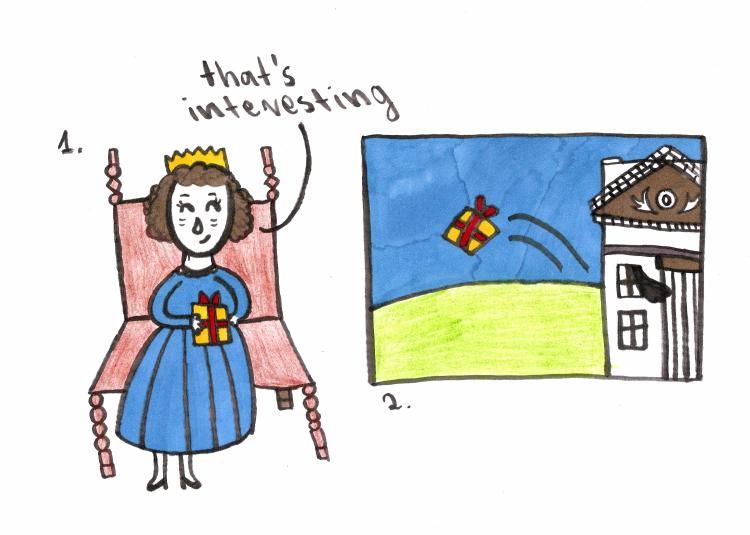
There are numerous articles translating expressions used by British people into normal language. For instance, when a British person says I agree up to a point, it actually means that they disagree with you. Or when they say that something could be better, it means that it’s very poor. And if you cook a meal and serve it to a British person who says that it tastes interesting…just throw away that recipe!

królowa

In his book The Right Mind*², the psychologist Robert Orstein tells a story of an American businessman visiting the UK. The businessman had just given a presentation to a group of British directors. After the presentation, one of the British directors stood up and said the following:

‘I’m not sure I, or anyone here, will agree completely with absolutely everything the speaker has said, but we thank him for his trouble in coming here to attempt to make a difficult idea possibly more clear to us.’

The Brits in the audience were shocked, but the American kept smiling. He didn’t get it.

In British English, the above sentence basically means ‘everything this guy said is bullshit.’ But British people rarely give feedback in such direct language. Foreigners (Americans included) find it very difficult to understand a British person when they are giving feedback in such an indirect style.

Growing up in the UK, you just naturally learn to communicate this way. It wasn’t until I lived abroad that I realised how confusing this can be.

So, can you trust the Angols? Well, I have to admit that the British style of giving feedback raises this very question. If we don’t say what we mean…explicitly and honestly…then how can you trust us? Why wouldn’t you believe that we’re trying to deceive you?

To defend the Angols, I’d like to point out that we’re just trying to be polite. In the UK it’s considered rude to express your opinions too directly.

So if an Angol doesn’t share his or her opinions very directly…if they confuse you with very opaque feedback…don’t worry, he or she is just trying to be polite

…because they do want to be your friend!


*I am from Scotland, but understand that the Polish term Angol refers to people from Britain and not just England.

*²p102, The Right Mind: Making Sense of the Hemispheres, Robert Ornstein, Hardcore Brace & Company 1997

HodgePodż

It’s hard work learning Polish.

At school I had learned German, which was easier because a lot of the vocabulary is similar to English. For instance, I didn’t have to learn the words for buch, finden or fussball – it’s like I got those ones for free. In Polish, however, the equivalent words are książka, odnaleźć and piłka nożna! For an English speaker there are no freebies when you learn Polish. You have to work hard for every word.

And that’s usually one advantage of having English as your mother tongue. Over the past 1500 years English has evolved or borrowed from so many different languages that you can expect some freebies when you’re learning any foreign tongue…except for Polish.

There’s an English expression hodgepodge (originally borrowed from French) which means a confused mixture of different things. And that’s how I’d describe the English language.

English started as a Germanic language, adopted Norse grammatical structures, then borrowed loads of words from Latin and French. During colonial times, it adopted words from various British colonies around the world: pyjamas (India), tomato (Aztec/Mexcio), and totem (Native American). Indeed, English has borrowed so many words from French that in Paris there’s a saying that English is a language for stupid French people.

But, returning to the challenge of learning Polish, I must say that first impressions can be deceptive. As you listen to Polish more and more, you start to hear English words in Polish sentences:

  • Dżinsy czy szorty?  (jeans or shorts)
  • On jest prawdziwym dżentelmenem  (he’s a real gentleman)
  • To jest mityng lekkoatletyczny  (it’s an athletics meeting)

And when an English-speaker learns how to spell particular sounds in Polish, then suddenly the English language magically reappears:

  • Dżungla…wait a second…is that the place where snakes and monkeys live?
  • I’m supposed to do what? Click on ‘lajkować’…ah… you mean the thumbs-up symbol.
  • A guy who rides a horse is a dżokej? Łał.

Previously I complained that there are no freebies when learning Polish…but that’s changing…and fast! Polish is acquiring English words at such a huge rate that in future a learner will only need to learn a few spelling rules to master the language!

Now I understand why Polish has borrowed words connected to modern technology – fejsbuk, hejter, smartfon – they’re new to English as well. But there are some words that Polish has borrowed from English that surprise me. Why did you borrow flirt, fair or weekend? Aren’t there Polish words for these?

hybryda_jpg

Whatever the reason, like the English language, Polish is becoming a hodgepodge…or should that be a hodżpodż?

So, to add to the hodżpodż, I offer you the following hybrid verb, a combination of the Polish verb przesadzać and the English verb to exaggerate.

przesadzerate, verb – when a Pole pessimistically predicts the death of the Polish language due to the influx of English words

Władysław: Język polski umiera

Rajan: Don’t przesadzerate!

Begging for Bilets

I remember the first time I tried to buy a ticket for public transport in Poland. I knew that you got them from those Ruch kiosks, and I knew what to say – I had the expression ‘bilet poproszę‘ (one ticket please) written on a scrap of paper in my pocket. There was a couple of minutes until the next bus. All set. What could possibly go wrong?

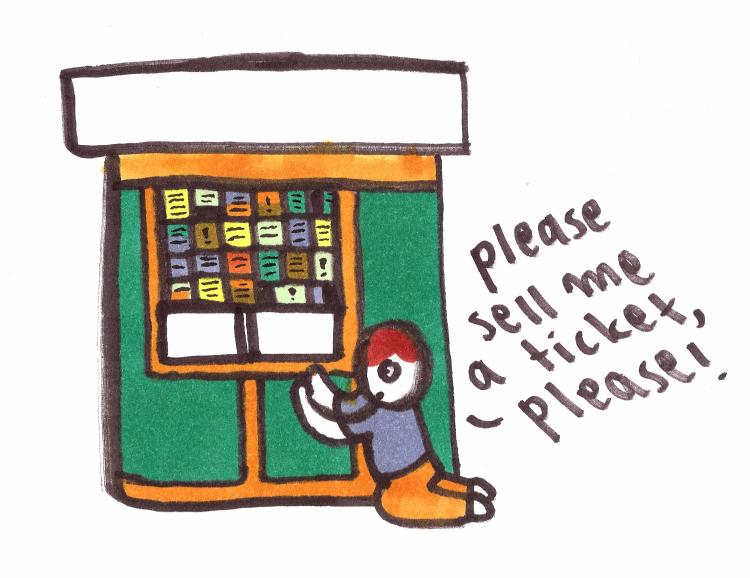
I approached the kiosk and the first thing I noticed was that the only opening was a small window at waist height. To communicate with the person inside, I had to bend forwards and turn my head sideways. Immediately I was in a submissive position, bent over like a servant as if I were begging at the feet of a king.

Through the small window, I could see someone inside. Although I couldn’t see his face, I could see the torso and hands of a man, who was sitting next to a heater and reading a magazine. It felt like I was interrupting.

kiosk

I cleared my throat and reading from my scrap of paper, I said ‘bilet poproszę

Instantly, the man inside the kiosk said ‘nie ma‘.

It was at this moment that I froze.

Coming from the UK, I am used to a high-level of politeness in customer service. If something is not available, then the shop assistant will say something like ‘sorry we don’t have any tickets, but if you go 100 yards down the street, you can find a shop that sells them.’ In this way, even if a shop assistant can’t help you, they at least pretend to.

What’s more, the shop assistant will usually respond by apologising and give the impression of regretting the fact that they can’t provide a customer with what they need. In the tone of their voice, you’ll also be able to hear a sense of empathy as if they were stepping into your shoes and feeling the same disappointment as the customer.

So I paused…waiting for the man in the kiosk to let me know where else I could get a ticket or when they would be back in stock. Anything to help me on my way.

But the guy in the kiosk said nothing…he just continued reading the magazine.

And the way he had said ‘nie ma‘… responding even before I’d finished saying ‘poproszę’. His response lasted a fraction of a second and it didn’t seem that he was going to put any more effort into the interaction. There was no empathy in his tone, no sense of regret. It was a simple statement of fact – there weren’t any tickets.

Yet my brain was so used to a familiar cultural pattern that I didn’t know what to do when the pattern was broken. I was stuck for a moment in a state of disbelief.

The bus arrived, some passengers got out, other got on. The bus departed.

But I was still at the kiosk, frozen in a bent-over position …slowly realising that I wasn’t going to get an apology, empathy, advice….and definitely not a ticket.

Reflections

  • I laughed when I later found out that ‘Ruch‘ means ‘movement‘…I associated it with being stuck and going nowhere.
  • I once wondered what it would be like if Ruch ran a project to train kiosk workers in customer service. Would the service be transformed? Probably not. Instead of a two-word reply, he’d just try and sell me stuff I didn’t need…only more politely.
  • Actually, a kiosk is a good place for a beginner to test their language skills in real world. You get a short, clear response to your questions – kiosk workers don’t tend to bamboozle you with long sentences or complex expressions.
  • Ruch has modernised their kiosks and in the most modern ones you can actually make eye contact with the person inside…without bending over. Opposite my apartment we even have a Ruchsalon handlowy‘…that’s what they call a kiosk you can walk three paces into.
  • Since that day I’ve had quite a few experiences in Poland in which the level of customer service I received didn’t live up to my expectations. I must say that I prefer the British style of interacting with customers. Customer service in the UK is polite and empathetic – very much focused on the relationship with the customer…but sometimes it’s also false. ‘Sorry, we don’t have any tickets, maybe if you try up the street?,’ is a just a polite way of saying ‘no, go somewhere else‘.
  • I hear lots of complaints about the quality of customer service in Poland, but there is one thing about it that I do appreciate…it’s honest. If there aren’t any tickets, then they’ll tell you that. No sugarcoating, no sales pitch, no pretense.

Nie ma.

Polish Idioms#1 – Cats

Idioms are mysterious…especially those in a foreign language. Why do they have this particular meaning? Where did they come from? Do people really use them?

In a way, idioms are like internet memes. At some point in history, someone created an expression that ‘went viral’ and became part of the language.

So I’ve decided to write some posts about my favourite Polish idioms – organized by category – to begin with…cats!

1. pierwsze koty za płoty

I first came across this idiom at work. Together with a colleague we were running a series of training sessions. After the first session had finished and the participants were leaving the room, my colleague said ‘pierwsze koty za płoty‘.

I could see that she was referring to the group of participants that were leaving the conference room. ‘Ah-hah,’ I thought, ‘we’re chasing the cats out of our garden. I wonder why? Maybe the cats were doing their business in the flower beds and we wanted to keep them away from the roses?” I assumed the idiom meant ‘to get rid of unwanted visitors’ like when it’s late and you want the party guests to leave so you can go to bed.

I later learned that the idiom actually means to complete the first step in a series of challenging tasks. And actually, in English we have a similar expression to describe a difficult task: it’s like herding cats.

2. kupować / kupić kota w worku

In English we have an idiom with the exact same meaning: ‘to buy a pig in a poke‘ (a poke is a bag or sack).

Despite using different animals, these two idioms are related. They both refer to a trick played in the middle ages in which a seller would sell what they claimed was a pig in a sack, but it was actually a cat. The buyer, if they didn’t check the contents first, would buy a cat, which is worth a lot less than a pig.

Incidentally, in English, we have another idiom – to let the cat out of the bag – which means to reveal hidden information / plans, and is directly related to the same trick. If you open the bag, reveal the cat, then you have exposed the trick. Curiously, this second cat idiom doesn’t seem to exist in Polish. Perhaps in Poland there’s better customer service and you simply return the kot and get a refund?

3. odwracać kota ogonem

I can visualise most idioms and imagine them in a scene (cats, fences, bags etc), but I just can’t picture this one.

I came across it in a comment posted under an interview with a politician. The commentator claimed that the politician had turned the cat around by its tail.

I checked the dictionary and discovered what it meant (twist everything around), but I couldn’t visualise how you would do it? Is the cat facing you or the listener? Do you turn the cat around sideways or flip it over like a hamburger? And how to avoid getting scratched?

When taking our cat to the vet, I struggle to get it into a cat carrier. How skillful do you need to be to turn the cat by its tail? Perhaps there is a YouTube video with ‘how to’ instructions?

I can understand how the first two idioms became part of the Polish language – they make sense – but this one? If it meant ‘doing something impossible‘ or ‘perform a miracle‘, then I could understand. But it describes a skill that someone can achieve. Wow!

4. kot po kupie

According to Katarzyna Mosiołek-Kłosińska*, there are 32 Polish idioms about cats and most of them portray cats as difficult or devious. Fortunately, the modern world appreciates cats much more – there are literally millions of cat pictures, videos and memes online. Indeed, a scientific study found that people who watch cat videos online feel more energetic and positive.

kot

Having two cats ourselves, my wife and I have created our own Polish cat idiom. After visiting the cat litter, our cats get a sudden burst of energy or joy and sprint through the apartment at top speed. Hence our proposal for a new cat idiom:

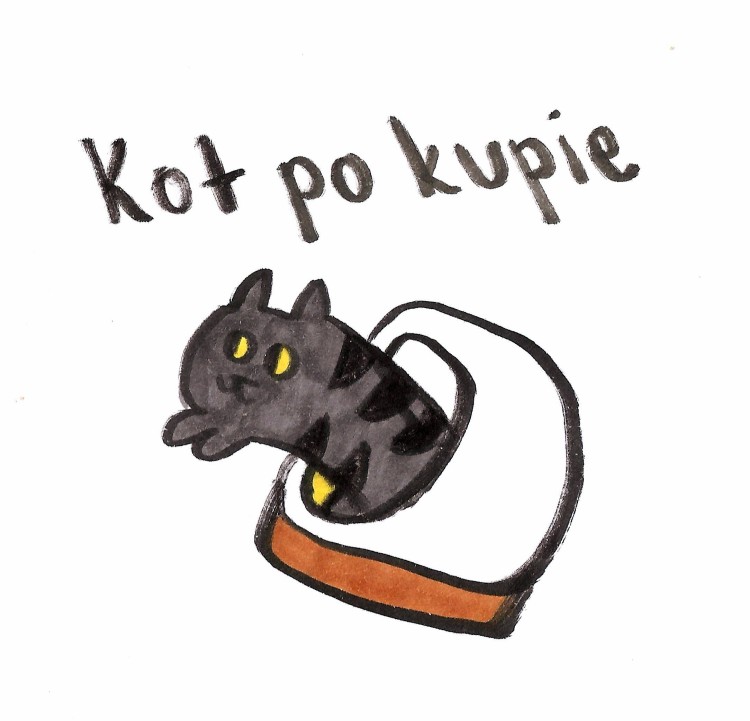
jak kot po kupie (like a cat after a crap) – meaning to be happy and energetic

  • Jak się masz?
  • Świetnie – Jak kot po kupie.


  • How you feeling?
  • Never better. I feel like a cat after a crap.


Will it become part of the Polish language? Probably not. I’m sure there were millions of failed idioms that didn’t catch on and died. But it’s worth trying.


*Katarzyna Mosiołek-Kłosińska, Motywacja Związków Frazeologicznych Zawierających Wyrazy „Pies” i „Kot”, [w:] Etnolingwistyka, tom 7, Uniwersytet Marii Curie-Skłodowskiej, Wydział Humanistyczny, Lublin 1995, s. 21 – 31.

The Sesame Street Strategy

Young kids are best at learning languages. But as adults we often forget all those techniques and strategies we used to learn our first language.

So when it came to learning Polish, I adopted some childlike strategies.

1. Name Tags

The first books that children read only contain names and pictures – cat, ball, bee etc – so that they can learn to associate words with things.

If only the real world had labels.

When I rented my first apartment in Warsaw, the first thing I did was to decorate it… using post-it notes!

polak

I labeled everything….and I mean absolutely every object in the apartment with its Polish name: łóżko, lodówka, szafa, podłoga (that one didn’t survive long), lustro, obraz, kwiatek. The entire apartment was covered in yellow post-it notes. At the time I hadn’t heard of Złota Polska Jesień, but that’s what the apartment looked like. When I opened a window the entire flat rustled like a chestnut tree in autumn.

Incidentally, Ikea should launch a line of furniture with labels where a language learner can write the name of the item in the foreign language they are learning. I’m sure it would it be a top seller.

2. The Count

In Sesame Street (Ulica Sezamkowa) there’s a Dracula-like character called ‘the Count’. Because his purpose is to teach children numbers, he counts everything. During my first few months in Poland, I adopted his strategy.

I prepared a water-proof cheat-sheet listing polish numbers from 1 to 500. I hung it in the bathroom so I could count in Polish while going through my bathroom routine every morning.

Typical counts:

  • Brushing my teeth – pięćdziesiąt
  • Showering – sto czterdzieści (dziewięćdziesiąt dziewięć if I was in a hurry)
  • Drying myself – trzydzieści

Most people only use this Sesame Street strategy to count the number of coffees they’ve drunk that morning. If you want to learn a foreign language, then I recommend extending it to your daily routine.

3. Copying

Children don’t learn their native language from textbooks with grammar exercises. They simply listen to what their parents or siblings say and copy it. I decided to adopt the same strategy. I would listen to Polish native speakers and copy what they said. Listen and copy, listen and copy.

So while traveling on the metro, I (and the rest of the children in the wagon) would repeat the names of the stations as they were announced. Or when a colleague ordered zupa pomidorowa in a restaurant, I’d order the same.

The one downside to this approach was that the person I mostly copied was my Polish girlfriend, so I ended up using the feminine form of most verbs. So instead of saying zadzwoniłem, I learned to say zadzwoniłam etc. But still, it was a step forward.

This strategy is more effective if you copy more than just the words. If you mimic the tone, the intonation and especially the emotion of the speaker, then not only is your pronunciation better, but you also start to get a feel for the language.

So when a cashier in a grocery shop asked for change, I would repeat the word ‘drobne‘ with the same world-weary tone of frustration and really feel the pain of not having enough tens, fives and ones.

False Friend#2 – Dziękuję

There are some words in different languages that might look the same and sound the same…but they don’t mean the same! That’s why they’re called ‘false friends‘.

While learning Polish, I’ve been tricked quite a few times. Here’s one of the worst (because it meant passing on wine):

thank you

I was having dinner with a group of colleagues from work. The waiter approached the table and offered wine to the guests. He came to me last.

Wino?”

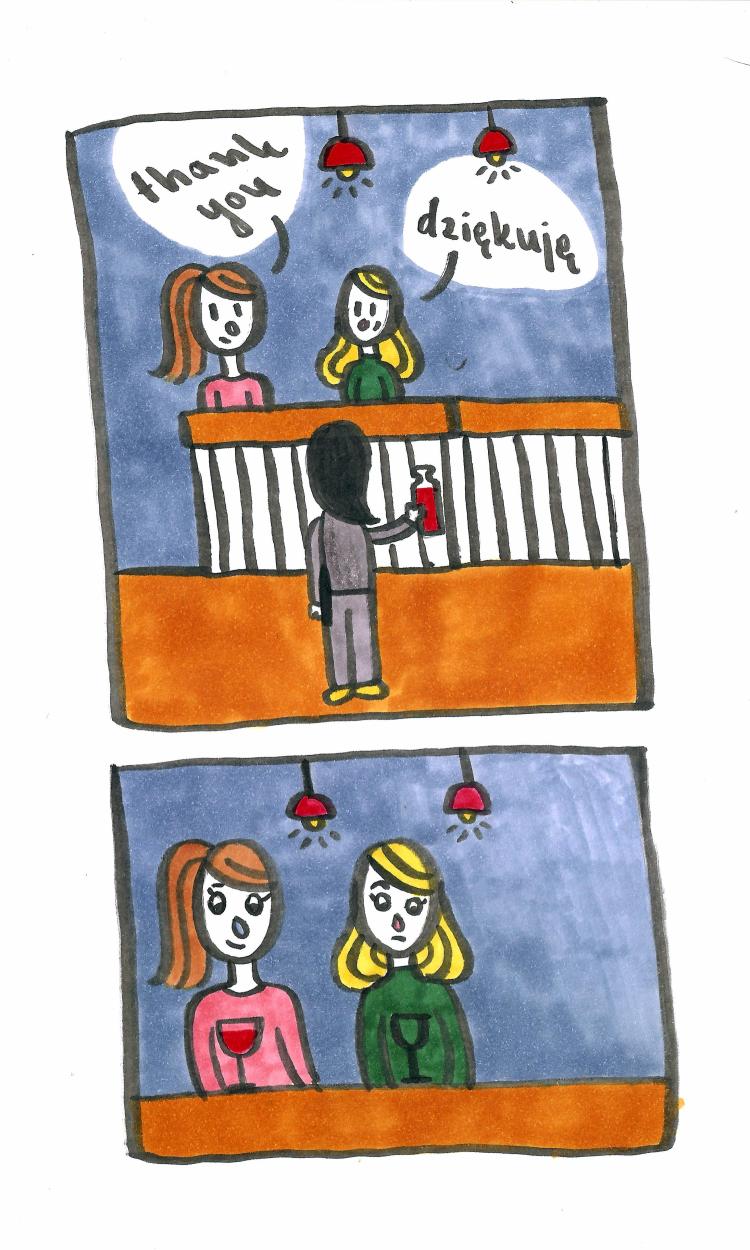
Dziękuję” I said and waited for him to pour the wine into my glass…but he had already left.

Learning by experience is powerful especially when you feel deprived of something! At first I didn’t understand. I assumed the waiter had misheard me. The next time he came around with the wine bottle, I observed a Polish companion put her hand on top of the wine glass (to block access) and say ‘Ja dziękuję‘.

Ah-hah! In Polish ‘dziękuję‘ means ‘no thanks!’ When the waiter offered me wine, I knew what not to say, but wasn’t sure what to say, so I just held up my glass as if I were begging. That did the trick.

In English, if you respond with the word ‘thank you‘ to an offer, it means ‘yes please‘. To decline, say ‘no thank you‘. In Polish, ‘dziękuję‘ means ‘no thank you‘. You need to say ‘poproszę‘ if you want to accept the offer.

It seemed strange to me that the word ‘thank you‘ could have a negative meaning (to decline an offer). In the UK, we say ‘thank you’ to the waiter because he is doing something for us (i.e. pouring wine). In Polish you need to say ‘thank you’ in order to stop him as if you should thank him for keeping you sober!

Another time I remember a business meeting during which we were discussing a supplier who wasn’t performing according to our expectations. One participant suggested that we should thank them (trzeba im podziękować).

I was confused. „They’re not doing their job properly and you want to thank them for it! Maybe we should send them some wine and flowers as well?

I hadn’t yet learned that ‘podziękować‘ can mean to fire/dismiss/end cooperation. In English we can say to ‘thank someone for their services‘ meaning to end cooperation, but it isn’t nearly as common as podziękować in Polish.

I learned that in Polish the verb dziękować often signals the end of something. Thanking is the final action before the end of any interaction, the last thing you need to do. In this way, in English it means something like ‘we’re done!‘.

Dziękuję.

Third Time Lucky

I once thought that if I stopped making mistakes, then my Polish would be better.

I employed a teacher for 1-2-1 lessons. At our first meeting, I told the teacher that if I made a mistake, she should interrupt immediately and correct me. She agreed and we started talking in Polish. I said two words, she stopped me and corrected me. I repeated the first two words again – this time correctly – and added a third word. She said stop, corrected me again… and so it went. It took ten minutes for me to finish the first sentence.

Hmm…I thought… maybe it was a mistake to try avoiding making mistakes. Were mistakes so bad? I had certainly made some good ones!

trzech_jpg

The first time I was invited for dinner in Poland, I wanted to buy some wine to give to my host. No problem, I knew the Polish word for wine was ‘wino‘, I just needed to know the word for dry and white so that I could buy some dry, white wine. I opened my English-Polish dictionary. White was biała and dry was suchy. I made a note on a scrap of paper – suchy biała wino.

I walked to local shop, took out my note and asked for suchy biala wino. The shop owner looked at me strangely.

„Białe wino…a wytrawne, półwytrawne, słodkie?

I switched to my standard emergency response ‘Nie rozumiem‘. He took down two bottles off the shelf. One said wytrawne, while the other was półwytrawne. Either wytrawne meant dry or sweet and pół probably meant ‘un-‘. I gambled that it meant sweet and bought półwytrawne.

I learned three things from this experience. One, that wine in Poland is wytrawne or słodkie. Two, that wytrawne means dry. And three that using a dictionary isn’t as simple as I thought.

Another time I was running a training session for a group of around 30 Poles. Holding up a clipboard, I asked if everyone had their podpaski (sanitary pads) so that they could make notes. The entire group burst into laughter. That was very powerful and immediate feedback. Ah-hah, I thought, I’ve used the wrong word and whatever it means, it’s pretty funny.

And one time, I used the verb to kiss (całować) rather than the verb to regret (załować). Instead of saying sorry and regretting what I’d done, I embraced my inappropriate actions by saying I wanted to kiss them.

Indeed, the more embarrassing the mistake, the more powerful the learning experience. There are load of Polish words I’ve learned because I got them wrong the first time.

I ended the 121 lessons after one meeting. I thought that if I stopped making mistakes, then my Polish would be better. But in the end I realised that if I stop making mistakes, my experience of learning Polish would be poorer….much much poorer.

English and Polish share an idiom – third-time lucky / do trzech razy sztuka – that sums up the process of learning through mistakes. In many cases, especially in language learning, you need to fail twice if you want to succeed the third time.