Shortcut#1 – Fake it til you Make it

It takes a long time to learn Polish, but if you’re confident enough, you can fake it. The verb to bluff in Polish is blefować, that’s right, it basically the English verb to bluff + ować. That’s what I’m proposing.

Here are three ways you can ‘fake it til you make it’:

1. -ować

A lot of Polish verbs end in -ować, especially those borrowed from other languages:

  • adapt = adaptować
  • decide = decydować
  • flirt = flirtować

I remember laughing out loud when I heard the Polish verb for saving a copy of data in a separate location is ‘backupować’. Perhaps Polish should borrow the grammatical structure as well and use ‘backować up‘:

  • Backowałem ten plik up

or

  • Backowałem ten plik do góry

Okay, maybe not.

Anyway if you don’t know a Polish verb, then just add -ować to the end of an English one. You’ll have a fair chance of being correct.

And if you want to turn the verb into a noun, add -owanie:

  • blefowanie
  • flirtowanie

You’ll need to decide yourself whether to say ‘backowanie up’ or ‘backupowanie’.

2. -ka

shortcuts_jpg

When talking about professions, use the English word for the male role. But remember to add – ka to the end of word if you’re talking about a woman:

  • barmanka
  • biznesmanka
  • wokalistka

Note that it doesn’t matter if the word contains the word ‘man’. Just stick a -ka on the end and it’s transformed into the female gender!

3. -czny / istyczny / -owy

For adjectives, it’s a little harder because there are two possible endings depending on the sound of the word:

  • drastic = drastyczny
  • mystic = mistyczny
  • snobby = snobistyczny

There’s one important exception to this rule: If you’re talking about something trendy, then you need to use ‘-owy‘ instead:

  • cult = kultowy
  • cool = coolowy
  • oldschool = oldschoolowy

If something was trendy but isn’t anymore, then perhaps the ending will change from -owy to -czny / -istyczny, i.e. in the future when cool is no longer cool, then Poles will say ‘coolistyczny‘.

Quirky Polish#2 – Canaries

One of the joys of learning a foreign language is that you come across strange expressions that completely confuse you.

quirky_jpg

I was once driving behind a bus which transported shoppers to and from a out-of-town shopping centre. On the back of the bus was an advert with a bird in a cage and the text ‘no canaries inside‘. I could have overtaken the bus, it was moving a lot slower than my car, but I wanted to work out what on earth the advert meant. If you wanted to encourage people to use your bus service, then why is it an advantage that there are no canaries inside?

My mind raced, going through all the possibilities I could think of:

  • Obviously, it wasn’t literal. If there was a canary inside the bus, then it would be a selling point. No need to stress that there aren’t any.
  • Canaries came from the Canary Islands originally, hence the name. Maybe the advert was selling holidays? Nope, still made no sense.
  • Besides being pets, canaries were used in coal mines to detect poisonous gases – maybe the advert meant that there’s no danger of being intoxicated by fumes in this bus service? Hardly a selling point.
  • The most famous canary I knew was Tweety Bird from the Warner Bros cartoons. Maybe I was Sylvester the cat and I should hunt the bus to the shopping centre? No, that still didn’t fit.

I was confused…completely confused.

Later that day I asked my wife and she explained that a ‘kanar‘ is a plain clothes ticker inspector who rides buses in search of fare-dodgers.

Ah-hah, I finally understood the advert – the bus service was free so there’s no danger of getting caught by any ticket inspectors!

Like a child, I asked lots of Poles why ticket inspectors are called ‘canaries’ but they didn’t know. Someone somewhere probably had a good reason for calling a ticket inspector a ‘canary’ and it caught on. Now it’s part of the language.

And that’s the fun of learning a foreign language. You come across words and expressions that will confuse you, surprise you and amuse you. Just enjoy the ride!

The Polish Language Test

In his Polish history God’s Playground, Norman Davies describes a test used by Polish troops during the 14th century to check whether a suspect was actually Polish:

“Investigations into the Cracovian revolt were assisted by a simple language test. Any suspect who could correctly pronounce ‘soczewica, koło, miele, młyn’ was judged loyal; he who faltered was guilty.”

Norman Davies, God’s Playground, volume 1, p77


Clearly, Polish words are so difficult to pronounce that foreigners can’t even pronounce simple words like wheel or mill correctly.

I actually had to undergo a similar test in a Notary office one day. Before he would notarize the document I was signing (which was in Polish), the notary insisted I read the document aloud to prove that I understood it. I read one sentence and he said ‘stop’. He had heard enough and by pronouncing one sentence correctly, I had passed the test.

tongue twister_jpg

On many occasions, I’ve experienced Poles using a variation on this technique. When they heard that I’m learning Polish, they immediately respond by asking me to repeat a tongue-twister about a beetle in Szczebrzeszyn (W Szczebrzeszynie chrząszcz brzmi w trzcinie). This has happened so often that I’m curious why.

Obviously, it’s difficult and Poles want to challenge a foreigner with some particularly tricky Polish pronunciation.

However, I sometimes wonder if it’s defensive too. Are they saying ‘don’t get so good at Polish that we don’t know you’re foreign anymore!’ and by hearing me fail, they are comforted that only real Poles can say the ridiculously difficult beetle tongue-twister?


False Friend#1 – Ewentualnie

There are some words in different languages that might look the same and sound the same…but they don’t mean the same! That’s why they’re called ‘false friends’.

While learning Polish, I’ve been tricked quite a few times. Here’s one of the worst (because it meant waiting for beer):

Myself and two friends once took an overnight train from Warsaw to Dresden. Before we left the station, the conductor came to our sleeping compartment, checked our tickets and said ‘if you want anything to eat or drink, just come to the last compartment where you can buy snacks, water, juice …’i ewentualnie piwo’.

Our ears pricked up at the word piwo – it was the start of a long weekend and we fancied a beer or two – but what did the conductor mean by ‘ewentualnie piwo‘?

None of us spoke Polish very well and we assumed that ‘ewentualnie‘ means the same as ‘eventually’ in English, meaning ‘after a period of time’ or ‘at the end’.

‘So we can buy beer eventually. What does that mean?’ asked one friend.

‘Maybe it means that we can buy it after a certain time or point in the journey?’ I replied

‘Yeah, they’re probably picking up the beer in Wrocław and we’ll be able to buy some after that,’ another friend agreed.

So we waited a few hours, checking our watches every few minutes and looking out of the window.

‘Any sign of Wrocław?’

‘No, we’re in somewhere called Leszno.’

‘Are they loading beer onto the train?’

‘Can’t see any.’

The journey was agonizingly slow, but finally the train passed through Wrocław and we went to buy three beers.

In a cruel world, there wouldn’t have been any beer left…but the train was quiet that night. Strangely, the beer was from Elbląg and it wasn’t even on the route!

Quirky Polish#1 – Saigon

The beauty of a language is that they evolve – words get attached to meanings and sometimes no one knows why. The expression sticks and every one uses it, but no one questions why it’s used.

That’s one of the joys of learning a foreign language – you come across such curious expressions for stuff.

quirky_jpg.jpg

So here is one of my favourite bizarre Polish expressions:

Saigon

To był kompletny saigon!

Poles use this expression when a situation or place is in a total mess or upheaval, a good English translation would be ‘disaster zone’.

Now there are some expressions that come with a date stamp, you know exactly in which period of history they come from.

Obviously, this expression came into being during the Vietnam War when Saigon wasn’t looking its best. So sometime during the late Sixties or early Seventies when the Vietnam War was in the news, some Poles started using the word and it caught on.

I often hear Poles in their 20’s or 30s using this expression even though they weren’t even born when the Vietnam War took place!

Jokingly I ask them why they haven’t updated the word, i.e. chosen a more freshly bombed out city to describe a messy situation. Why not Bagdad or Grozny? But then again, that probably wouldn’t be a good idea.

If you’re Vietnamese, wouldn’t you find this expression would be a little offensive? Imagine another culture that heard about the destruction of Warsaw during World War II and it became common in that language to use the word ‘Warsaw’ to describe something that is a total mess. ‘The event was a complete Warsaw‘. Not exactly good PR.

First Words

The first 3 words I learned in Polish were:

  1. cześć
  2. żywiec
  3. chodź

I arrived in Poland in February 1998. I knew one Polish word (cześć), and the only famous Poles I had heard of were John Paul II, Zbigniew Boniek and Lech Wałęsa. I didn’t know a thing about Polish culture, history or food. No worries, I thought, I’ll absorb it all on site. It wasn’t as easy as I’d imagined.

Word#1: Cześć

I figured that the best place to pick up Polish is in Poland itself, so I didn’t bother studying beforehand. I did however buy a small phrase book and spent the flight to Warsaw trying to pronounce the greeting ‘cześć. After greeting a Polish person with this word, my plan was to switch to English.

I did notice that the word ‘cześćand ‘Wałęsa’ contained some strange symbols. The ‘e’ had a tail, the ‘l’ had a belt and both the ‘s’ and ‘c’ had little hats. So the Poles like to dress up their letters, I thought. That’s nice…just as long as it’s the same, familiar letters underneath.

In practice, not a single Pole understood my pronunciation of ‘cześć‘ anyway and we switched to English immediately.


Word#2: Żywiec


small beer_jpg

I spent my first evening in Poland with some new work colleagues and we went out for a beer. When it was my turn to buy a round, I approached the bar and asked (in English) for three beers. The barman responded by asking ‘Żywiec?”

I quickly discovered that Polish beer was good but that it was a challenge ordering it. In fact, it took me three months just to learn how to pronounce the name ‘Żywiec’. As soon as my anglo-saxon mind stared at those 6 letters, there was no way to even begin saying the name. And course, as hard as I tried to memorize it, the effect of the beer washed away the memory and by the next morning I was back to square one. I knew some British guys who drank ‘Lech’ just because it was easier to pronounce!


Word#3: Chodź

On day 2 I went for a walk. Walking down the street, I saw a dog walker turn to their dog who was busy sniffing in the bushes and say ‘chodź‘. The dog immediately looked up and ran over to its owner. ‘Ah-hah I said to myself, ‘chodź‘ must be the name of the dog’. In fact, it seemed to be the most popular name for a dog in Poland, like ‘rover’ or ‘spot’ in the Anglo-Saxon world. Most dog owners were using it. For a time I used to think that the most popular name for a dog in Poland was ‘chodź’. Then I heard some owners using a longer version of the name: ‘chodź tu’, and I was confused. After some hard thinking I deduced two possibilities – either ‘chodź’ was a shorter version of ‘chodź tu’, a little like Bob being short version of Robert – or that this owner had previously owned a dog called ‘chodź‘ who had died tragically and then bought a new dog whom they had christened ‘chodź two’. The next dog would probably be called ‘chodź three’…

So that was my start in learning Polish – two words I couldn’t pronounce and a third I didn’t understand. Perhaps it wasn’t going to be so easy.


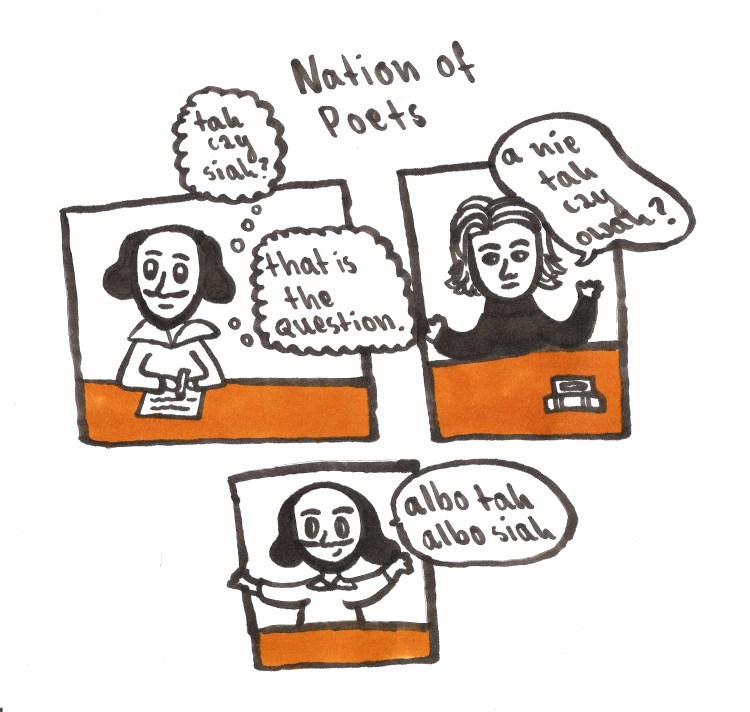
Nation of Poets#1

poets_jpg


Poles use a lot of rhyming expressions in everyday speech. The most famous is smigus dyngus – a rhyming name that sounds silly, but which actually fits well with the type of activity it describes!

I once told a friend that I like these rhyming expressions in Polish and he said:

‘What can I say? We’re a nation of poets!’

So to celebrate this nation of poets, here are some of my favourites:

Ryzyk Fizyk

This means well, it’s worth taking the chance.

It’s actually quite persuasive when someone says this. Including the word ‘fizyk/physics’ suggests that we’re not talking about ‘chance’ but the mechanical laws of the universe!

It was probably coined by Kopernik when the church were considering publishing his research!

Tak Czy Siak

  • tak czy siak
  • tak czy owak
  • albo tak, albo siak

These expressions mean ‘in any case, anyway or for better or worse. The rhyming works well to express that we’re talking about something that doesn’t matter.

What is a ‘siak’ anyway? Whatever it is, it similar to an ‘owak’ and it’s always an option. If you don’t like the first option, there’s always the ‘siak’ option.

In Chinese, the word tao means ‘way’ or ‘route’ and signifies the path to spiritual enlightenment in Taoism. For a Polish equivalent, then I offer you Siakism or Siakizm. If you are in two minds, then choose the way of Siak – it might not be a well-trodden path, but hey ‘ryzyk fizyk!’

Prosto z Mostu

Literally, ‘straight from the bridge‘. When I first heard this expression, I assumed it described having ‘first hand’ information about something – as if to get the best view of what’s happening, you should go and stand on the bridge! This made sense to me because the idiom does mention a specific location.

However, I learned that it actually means ‘bluntly’ and describes a communication style that is very direct or even rude.

As locations go, I wouldn’t describe the bridge as being the most vulgar. The sewer or the gutter maybe, but the bridge?