Muchomore, Mucholess

One regret I have about living in Poland is that my Polish wife doesn’t like mushroom-picking and has never taken me on a trip to the forest with a basket. One of the rites of passage for foreigners into Polish culture is the first time they are invited to go mushroom-picking. My wife has failed to give me this basic initiation …and education.

As far as mushrooms are concerned, my mental basket is empty.

In the UK we don’t have many forests left. That’s why, we don’t have much affection for mushrooms despite the wet climate. To us, mushrooms are small, white buttons that you buy in plastic-wrapped packs in Tesco. They are grown in darkened warehouses and don’t have any taste. Indeed, the only people who actually go mushroom-picking in the UK are desperate students looking for a psychedelic experience.

Consequently, English speakers only use one word for the fungi that grows in the woods – mushroom. If you want to define them more precisely, then we borrow from French – chanterelle, champingon etc.

In Poland, however, mushrooms are a passion and their appearance marks a time of the year. Not only are they a delicious food, but they are a hobby, a source of income and an activity that unites the whole family. The entire population can get involved – you just need to get up early enough and know where to look.

While English speakers only use one generic expression, Polish has the generic name grzyby, as well as a different name for each type of mushroom – borowik/prawdziwek, rydz, kurka, kania, pieczarka, maślak, gąska, koźlarz, podgrzybek, zajączek. And all Poles know the difference between a kurka and a gąska from 100 metres away through a dark, damp forest.

In English, we do have a specific word for the poisonous mushroom known in Polish as muchomor. It’s called a toadstool, i.e. a chair that a toad can sit on. This makes it sound quite harmless… even cute. At least in Polish, they give cute names to edible mushrooms – kurka (little chicken), gąska (little goose) and zajączek (little hare), while giving aggressive names to poisonous mushrooms – szatan (satan), and muchomor (fly-killer). Now that’s a clear message!

grzyby

Whenever I ask Poles how they acquired this skill, the answer is pretty much the same:

Me: How did you learn all this?

Pole: When I was a child my grandma (or grandpa) took me to the woods to pick mushrooms. Didn’t your grandma take you?

Me: No.

Pole: Why not?

Me: Well, we don’t have forests. We cut down all the trees centuries ago to build ships.

Pole: That’s a shame.

Me: Yes, we gained an empire, but we lost the opportunity to go mushroom-picking.

Pole: There must be some forests left.

Me: A few. But, in any case, my grandma wouldn’t know the difference between a mushroom and toadstool. If she had taken me mushroom-picking as a child, then I probably wouldn’t be here talking to you now.

I worry about the consequences of not learning this crucial Polish skill. I’ve tried to warn my wife – what if there’s another war and we have to live wild in the forest? Not knowing the difference between a szatan and a prawdziwek, I will probably be poisoned before the first shot is fired!

So far my arguments haven’t convinced her… I’m still hunting for mushrooms in Tesco.
Polish Idioms#1 – Cats

Idioms are mysterious…especially those in a foreign language. Why do they have this particular meaning? Where did they come from? Do people really use them?

In a way, idioms are like internet memes. At some point in history, someone created an expression that ‘went viral’ and became part of the language.

So I’ve decided to write some posts about my favourite Polish idioms – organized by category – to begin with…cats!

1. pierwsze koty za płoty

I first came across this idiom at work. Together with a colleague we were running a series of training sessions. After the first session had finished and the participants were leaving the room, my colleague said ‘pierwsze koty za płoty‘.

I could see that she was referring to the group of participants that were leaving the conference room. ‘Ah-hah,’ I thought, ‘we’re chasing the cats out of our garden. I wonder why? Maybe the cats were doing their business in the flower beds and we wanted to keep them away from the roses?” I assumed the idiom meant ‘to get rid of unwanted visitors’ like when it’s late and you want the party guests to leave so you can go to bed.

I later learned that the idiom actually means to complete the first step in a series of challenging tasks. And actually, in English we have a similar expression to describe a difficult task: it’s like herding cats.

2. kupować / kupić kota w worku

In English we have an idiom with the exact same meaning: ‘to buy a pig in a poke‘ (a poke is a bag or sack).

Despite using different animals, these two idioms are related. They both refer to a trick played in the middle ages in which a seller would sell what they claimed was a pig in a sack, but it was actually a cat. The buyer, if they didn’t check the contents first, would buy a cat, which is worth a lot less than a pig.

Incidentally, in English, we have another idiom – to let the cat out of the bag – which means to reveal hidden information / plans, and is directly related to the same trick. If you open the bag, reveal the cat, then you have exposed the trick. Curiously, this second cat idiom doesn’t seem to exist in Polish. Perhaps in Poland there’s better customer service and you simply return the kot and get a refund?

3. odwracać kota ogonem

I can visualise most idioms and imagine them in a scene (cats, fences, bags etc), but I just can’t picture this one.

I came across it in a comment posted under an interview with a politician. The commentator claimed that the politician had turned the cat around by its tail.

I checked the dictionary and discovered what it meant (twist everything around), but I couldn’t visualise how you would do it? Is the cat facing you or the listener? Do you turn the cat around sideways or flip it over like a hamburger? And how to avoid getting scratched?

When taking our cat to the vet, I struggle to get it into a cat carrier. How skillful do you need to be to turn the cat by its tail? Perhaps there is a YouTube video with ‘how to’ instructions?

I can understand how the first two idioms became part of the Polish language – they make sense – but this one? If it meant ‘doing something impossible‘ or ‘perform a miracle‘, then I could understand. But it describes a skill that someone can achieve. Wow!

4. kot po kupie

According to Katarzyna Mosiołek-Kłosińska*, there are 32 Polish idioms about cats and most of them portray cats as difficult or devious. Fortunately, the modern world appreciates cats much more – there are literally millions of cat pictures, videos and memes online. Indeed, a scientific study found that people who watch cat videos online feel more energetic and positive.

kot

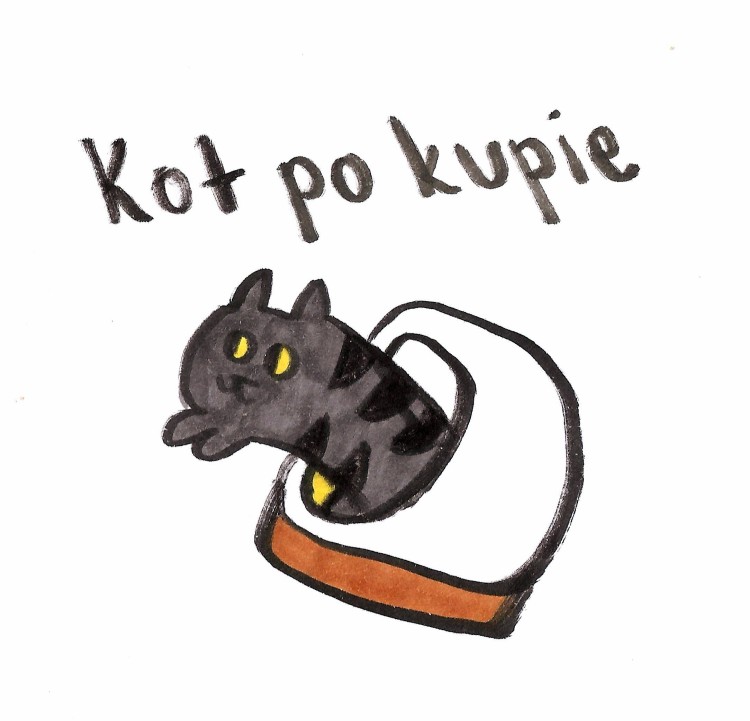
Having two cats ourselves, my wife and I have created our own Polish cat idiom. After visiting the cat litter, our cats get a sudden burst of energy or joy and sprint through the apartment at top speed. Hence our proposal for a new cat idiom:

jak kot po kupie (like a cat after a crap) – meaning to be happy and energetic

  • Jak się masz?
  • Świetnie – Jak kot po kupie.


  • How you feeling?
  • Never better. I feel like a cat after a crap.


Will it become part of the Polish language? Probably not. I’m sure there were millions of failed idioms that didn’t catch on and died. But it’s worth trying.


*Katarzyna Mosiołek-Kłosińska, Motywacja Związków Frazeologicznych Zawierających Wyrazy „Pies” i „Kot”, [w:] Etnolingwistyka, tom 7, Uniwersytet Marii Curie-Skłodowskiej, Wydział Humanistyczny, Lublin 1995, s. 21 – 31.

The Sesame Street Strategy

Young kids are best at learning languages. But as adults we often forget all those techniques and strategies we used to learn our first language.

So when it came to learning Polish, I adopted some childlike strategies.

1. Name Tags

The first books that children read only contain names and pictures – cat, ball, bee etc – so that they can learn to associate words with things.

If only the real world had labels.

When I rented my first apartment in Warsaw, the first thing I did was to decorate it… using post-it notes!

polak

I labeled everything….and I mean absolutely every object in the apartment with its Polish name: łóżko, lodówka, szafa, podłoga (that one didn’t survive long), lustro, obraz, kwiatek. The entire apartment was covered in yellow post-it notes. At the time I hadn’t heard of Złota Polska Jesień, but that’s what the apartment looked like. When I opened a window the entire flat rustled like a chestnut tree in autumn.

Incidentally, Ikea should launch a line of furniture with labels where a language learner can write the name of the item in the foreign language they are learning. I’m sure it would it be a top seller.

2. The Count

In Sesame Street (Ulica Sezamkowa) there’s a Dracula-like character called ‘the Count’. Because his purpose is to teach children numbers, he counts everything. During my first few months in Poland, I adopted his strategy.

I prepared a water-proof cheat-sheet listing polish numbers from 1 to 500. I hung it in the bathroom so I could count in Polish while going through my bathroom routine every morning.

Typical counts:

  • Brushing my teeth – pięćdziesiąt
  • Showering – sto czterdzieści (dziewięćdziesiąt dziewięć if I was in a hurry)
  • Drying myself – trzydzieści

Most people only use this Sesame Street strategy to count the number of coffees they’ve drunk that morning. If you want to learn a foreign language, then I recommend extending it to your daily routine.

3. Copying

Children don’t learn their native language from textbooks with grammar exercises. They simply listen to what their parents or siblings say and copy it. I decided to adopt the same strategy. I would listen to Polish native speakers and copy what they said. Listen and copy, listen and copy.

So while traveling on the metro, I (and the rest of the children in the wagon) would repeat the names of the stations as they were announced. Or when a colleague ordered zupa pomidorowa in a restaurant, I’d order the same.

The one downside to this approach was that the person I mostly copied was my Polish girlfriend, so I ended up using the feminine form of most verbs. So instead of saying zadzwoniłem, I learned to say zadzwoniłam etc. But still, it was a step forward.

This strategy is more effective if you copy more than just the words. If you mimic the tone, the intonation and especially the emotion of the speaker, then not only is your pronunciation better, but you also start to get a feel for the language.

So when a cashier in a grocery shop asked for change, I would repeat the word ‘drobne‘ with the same world-weary tone of frustration and really feel the pain of not having enough tens, fives and ones.

Nation of Poets#2 – Geography

Poles use a lot of rhyming expressions in everyday speech. The most famous is ‘smigus dyngus‘ – a rhyming name that sounds silly, but which actually fits well with the type of activity it describes!

I once told a friend that I like these rhyming expressions in Polish and he said:

What can I say? We’re a nation of poets!

So to celebrate this nation of poets, here are some of my favourites. This week two expressions that include cities / countries:

Jedno oko na Maroko, a drugie na Krym

nation2

What an excellent example of Polish poetry – using a rhyme to describe a physical feature, in this case, a squint (zez), i.e. one of the eyes looks west towards Maroko, while the other looks east towards Crimea.

Now this is quite a squint with both eyes looking very far apart. I wonder if Polish allows for smaller differences, i.e. jedno oko na Monako, a drugie na Kijów? Monaco isn’t as far west as Maroko so this would describe someone whose eyes are only slightly out of alignment.

Actually, just thinking about this idiom gives me a squint (see Shakespeare above).

Życie jak w Madrycie

Literally, this means ‘life like in Madrid‘ and describes a lifestyle that is fun and luxurious. To me, this is one example in which Poles have chosen a city that rhymes over a city that has an especially vibrant lifestyle. I mean ‘life in Paris or Rome‘ might have been better choices, but they don’t rhyme with życie.

All in all, this expression is great PR for Madrid, and I wonder whether any Poles have taken a holiday in Madrid just because they anticipated a fantastic nightlife? Perhaps the expression was created by a Spanish marketing agency to build a positive image about the Spanish capital?

With that in mind, I can imagine a Polish tourist agency trying to do the same thing by creating a rhyming idiom about a town or city in Poland:

  • Get it on in Ustroń
  • Party hard in Nowy Targ
  • Oh-la-la Dukla
  • Live in up in Gołdap
  • If it’s in, it’s Ryn
  • You and I, Biłgoraj
  • Run amok in Sanok
  • The nights are long in Elbląg
  • Live a lot in Sopot
  • Woo-woo Łódź
  • Shake your bun in Wieluń
  • Make a Wish, Przasnysz

If ‘live it up in Gołdap‘ became a common expression in English, then the tourist industry in the town of Gołdap would clearly receive a significant boost. Or if ‘You and I, Biłgoraj‘ was included in the Cambridge dictionary, then perhaps Biłgoraj would become a honeymoon destination like Paris or Niagara Falls. Or if ‘Make a Wish, Przasnysz‘ went viral, then maybe the next Disney theme park would be built in Mazowsze.

Imagine that!

False Friend#2 – Dziękuję

There are some words in different languages that might look the same and sound the same…but they don’t mean the same! That’s why they’re called ‘false friends‘.

While learning Polish, I’ve been tricked quite a few times. Here’s one of the worst (because it meant passing on wine):

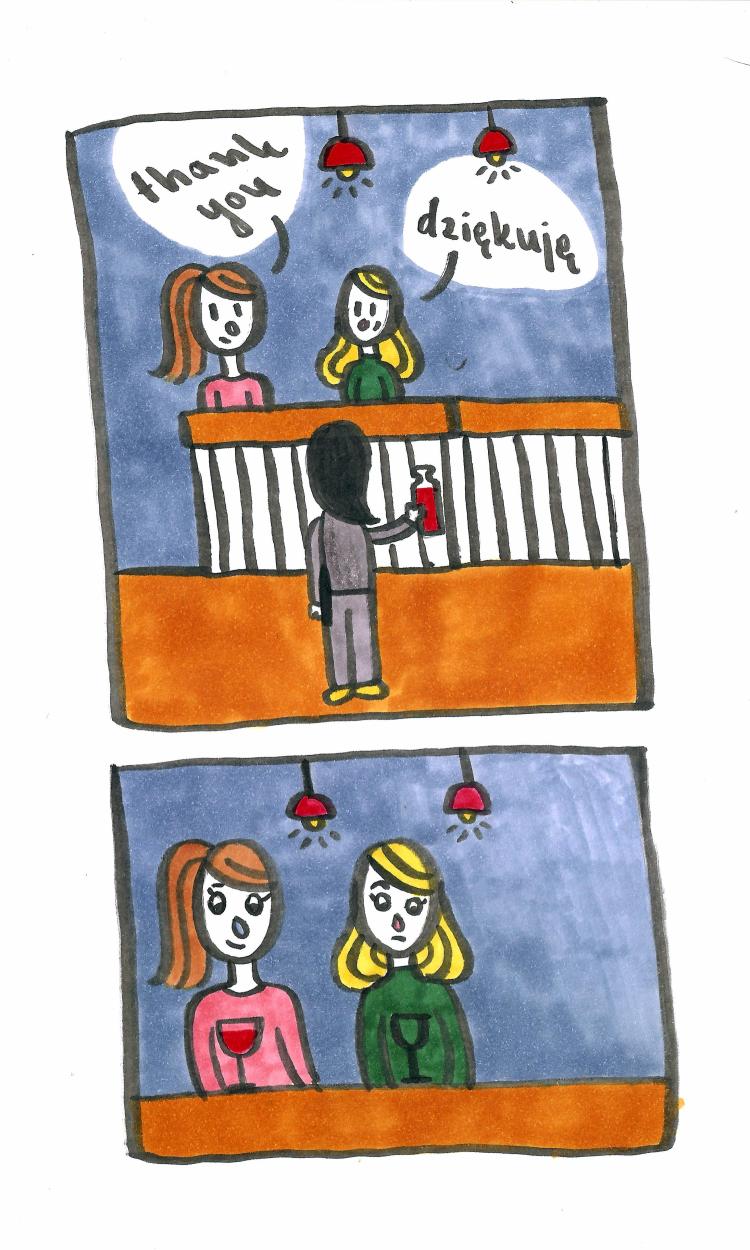
thank you

I was having dinner with a group of colleagues from work. The waiter approached the table and offered wine to the guests. He came to me last.

Wino?”

Dziękuję” I said and waited for him to pour the wine into my glass…but he had already left.

Learning by experience is powerful especially when you feel deprived of something! At first I didn’t understand. I assumed the waiter had misheard me. The next time he came around with the wine bottle, I observed a Polish companion put her hand on top of the wine glass (to block access) and say ‘Ja dziękuję‘.

Ah-hah! In Polish ‘dziękuję‘ means ‘no thanks!’ When the waiter offered me wine, I knew what not to say, but wasn’t sure what to say, so I just held up my glass as if I were begging. That did the trick.

In English, if you respond with the word ‘thank you‘ to an offer, it means ‘yes please‘. To decline, say ‘no thank you‘. In Polish, ‘dziękuję‘ means ‘no thank you‘. You need to say ‘poproszę‘ if you want to accept the offer.

It seemed strange to me that the word ‘thank you‘ could have a negative meaning (to decline an offer). In the UK, we say ‘thank you’ to the waiter because he is doing something for us (i.e. pouring wine). In Polish you need to say ‘thank you’ in order to stop him as if you should thank him for keeping you sober!

Another time I remember a business meeting during which we were discussing a supplier who wasn’t performing according to our expectations. One participant suggested that we should thank them (trzeba im podziękować).

I was confused. „They’re not doing their job properly and you want to thank them for it! Maybe we should send them some wine and flowers as well?

I hadn’t yet learned that ‘podziękować‘ can mean to fire/dismiss/end cooperation. In English we can say to ‘thank someone for their services‘ meaning to end cooperation, but it isn’t nearly as common as podziękować in Polish.

I learned that in Polish the verb dziękować often signals the end of something. Thanking is the final action before the end of any interaction, the last thing you need to do. In this way, in English it means something like ‘we’re done!‘.

Dziękuję.

Third Time Lucky

I once thought that if I stopped making mistakes, then my Polish would be better.

I employed a teacher for 1-2-1 lessons. At our first meeting, I told the teacher that if I made a mistake, she should interrupt immediately and correct me. She agreed and we started talking in Polish. I said two words, she stopped me and corrected me. I repeated the first two words again – this time correctly – and added a third word. She said stop, corrected me again… and so it went. It took ten minutes for me to finish the first sentence.

Hmm…I thought… maybe it was a mistake to try avoiding making mistakes. Were mistakes so bad? I had certainly made some good ones!

trzech_jpg

The first time I was invited for dinner in Poland, I wanted to buy some wine to give to my host. No problem, I knew the Polish word for wine was ‘wino‘, I just needed to know the word for dry and white so that I could buy some dry, white wine. I opened my English-Polish dictionary. White was biała and dry was suchy. I made a note on a scrap of paper – suchy biała wino.

I walked to local shop, took out my note and asked for suchy biala wino. The shop owner looked at me strangely.

„Białe wino…a wytrawne, półwytrawne, słodkie?

I switched to my standard emergency response ‘Nie rozumiem‘. He took down two bottles off the shelf. One said wytrawne, while the other was półwytrawne. Either wytrawne meant dry or sweet and pół probably meant ‘un-‘. I gambled that it meant sweet and bought półwytrawne.

I learned three things from this experience. One, that wine in Poland is wytrawne or słodkie. Two, that wytrawne means dry. And three that using a dictionary isn’t as simple as I thought.

Another time I was running a training session for a group of around 30 Poles. Holding up a clipboard, I asked if everyone had their podpaski (sanitary pads) so that they could make notes. The entire group burst into laughter. That was very powerful and immediate feedback. Ah-hah, I thought, I’ve used the wrong word and whatever it means, it’s pretty funny.

And one time, I used the verb to kiss (całować) rather than the verb to regret (załować). Instead of saying sorry and regretting what I’d done, I embraced my inappropriate actions by saying I wanted to kiss them.

Indeed, the more embarrassing the mistake, the more powerful the learning experience. There are load of Polish words I’ve learned because I got them wrong the first time.

I ended the 121 lessons after one meeting. I thought that if I stopped making mistakes, then my Polish would be better. But in the end I realised that if I stop making mistakes, my experience of learning Polish would be poorer….much much poorer.

English and Polish share an idiom – third-time lucky / do trzech razy sztuka – that sums up the process of learning through mistakes. In many cases, especially in language learning, you need to fail twice if you want to succeed the third time.

77 Words for…#1 – Meat

They say that Eskimos have 77 different words for snow. It’s probably an urban myth, but, since snow is part of their everyday experience, I’m sure they have a lot of words to describe it.

If something is important to a particular culture, then it’s natural that they develop a rich vocabulary to discuss it.

In British English, for example, we have at least 77 words to describe drunkenness (pissed, plastered, rat-faced etc) and your level of drunkenness (tipsy, merry, paralytic etc) – it’s a common feature of our everyday experience.

So I wonder what’s the Polish equivalent? What is so important to Polish culture that a broad and nuanced vocabulary has evolved to describe it?

resturant

Here’s one possibility.

In a bar where I used to eat lunch everyday, the menu is pinned to the wall and as the queue approaches the counter, you have time (but not much time) to read the menu and choose what you want to order. The challenge (except on Fridays) is to understand the difference between various types of meat.

This bar regularly serve the following:

  • sznycel
  • filet
  • bitki
  • befsztyk
  • rumsztyk
  • eskalop
  • medalion
  • zraz
  • kotlet
  • stek
  • bryzol
  • pieczeń

On a typical day, the menu includes 5 of the above meat choices plus one vegetarian option. What’s the difference is between zraz, bitki and bryzol? Aren’t they all just pieces of meat? Well, one day the menu actually included sztuka mięsa…so no zraz, bitki and bryzol aren’t pieces of meat because ‘piece of meat’ is another menu option!

Because there’s not much time to make a decision, I usually play safe and order kotlet. That’s the challenge with learning words for food – you learn by experience, but when you’re hungry, it’s not the time to take a risk.

Also, with unknown foods, I usually make a judgment based on the sound of the word. Bryzol, for instance, sounds like a product for cleaning the bathroom, zraz sounds like a sports injury, and bitki sounds like what’s left on the field after a battle. Sorry, but I have 30 minutes for lunch before I’m due back at my desk, just give me a kotlet with potatoes!

Key Polish Expressions#1 – The Words you Hear Everywhere

I heard about a British guy who didn’t speak nor understand Polish, but he’d lived in Poland for a while and heard the language being spoken a lot. It was all meaningless communication to him, except that there was one word that he heard over and over. He heard it on buses and trams, he heard mothers saying it to their children, he heard owners shouting it at their dogs, he heard it from politicians on TV and from loudspeakers outside churches. But he didn’t know what it meant. He came to the conclusion that it must be the most important word in Polish society, otherwise they wouldn’t repeat it all the time.

But what was it?

What did it mean?

And why was it so common?

The word was ‘Nie wolno…‘.

And if you listen carefully, you can hear it all the time.

Here’s another expression you hear a lot:

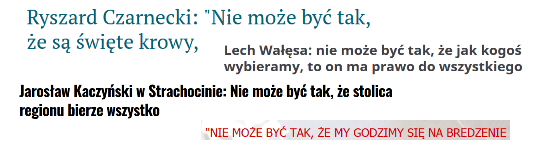
If you listen to Polish politicians on the TV or radio, there’s one expression that they use over and over. No matter which subject they’re discussing – the EU, the budget, the constitution – they introduce their opinion by saying:

Nie może być tak, że…‘ (We can’t accept that…)

nie moze byc tak ze

Basically, they’re saying that whatever situation exists right now, it can’t continue like this. They rarely offer an alternative, but they are good at pointing out exactly what ‘nie może być‘.

The most common sign in Poland has the word ‘zakaz‘ (it’s forbidden to…) written in big capital letters across the top, followed by whatever activity is forbidden – parking, playing ball games, feeding the birds. Even if you don’t understand Polish, it’s very obvious what ‘zakaz‘ means – the sign is usually bright red and often there’s a image showing what’s forbidden.

Curiously, despite the popularity of these expressions, they don’t work.

  • Nie wolno – this is used when someone (often a child) is already doing what’s forbidden. Saying ‘nie wolno‘ won’t stop them, at best it will lead to the response ‘why not?’
  • Nie może być tak, że – whatever subject is being discussed, it will become more popular because now more people know about it.
  • Zakaz – people are already doing this activity in this place – that’s why it was necessary to put up the sign in the first place. Adding the sign just gives people a reminder that this is a good place to park, play ball games, swim etc.

If there’s one thing I’ve learned living in Poland, it’s that despite all these reminders about what people can’t or shouldn’t do, Poles will do it anyway!

So that British guy who heard ‘nie wolno‘ everywhere but didn’t understand what it meant, well, it turns out that he was paying more attention to the expression that most Poles do!


headlines from http://wyborcza.pl/7,75398,21877293,jaroslaw-kaczynski-w-strachocinie-nie-moze-byc-tak-ze-stolica.html; http://www.polsatnews.pl/wiadomosc/2017-08-31/lech-walesa-nie-moze-byc-tak-ze-jak-kogos-wybieramy-to-on-ma-prawo-do-wszystkiego/; https://wpolityce.pl/polityka/342152-ryszard-czarnecki-nie-moze-byc-tak-ze-sa-swiete-krowy-ze-jak-ktos-byl-premierem-i-lgal-jak-najety-to-nie-bedzie-pociagniety-do-odpowiedzialnosci

Diego in Zakopanego

There’s a rumour that Polish is the 3rd hardest language for English speakers to learn. After a few months in Poland, I thought this claim was exaggerated. Sure, the numbers and pronunciation were hard work, but I had managed to pick up quite a few words and expressions. This is not so bad, I thought. But then I started learning Polish grammar!

I was surprised when I learned that Polish has seven cases. I was even more shocked when I learned that nouns and names change depending on the case… as the following anecdote demonstrates:

I was planning to take a trip to the Tatry mountains and went to the railway station to buy a ticket. Of course, I had prepared in advance, using a dictionary and in my pocket was a slip of paper with ‘one ticket please‘ written in Polish (along with a phonetic version so I could pronounce it correctly). I thought it would be a piece of cake.

Me: poproszę jeden bilet do Zakopane

Cashier: do Zakopanego?

Me: Nie, Zakopane.

I’d never heard of Zakopanego and I didn’t want to go there for a long weekend!

The cashier eventually sold me a ticket to Zakopane and I checked it carefully to make sure that I had bought a ticket to ‘Zakopane’ and not some other town with a similar name.

In English we don’t have ‘cases’. A noun doesn’t change in any way. A ‘book’ is always just a ‘book’ It doesn’t matter if you’re giving it to someone, throwing it away or jumping up and down on it. The spelling doesn’t change.

But in Polish…with all these cases…the names of things, people and places keeps changing. It can be very confusing.

It’s especially confusing with names. ‘You mean, you’re not called Piotr when I go somewhere with you? Then you’re Piotrem! And if I buy Piotr a present, it’s not actually for Piotr, but for some guy called Piotra!‘ Sounds a bit schizophrenic to me…all these different identities!

3 Piotrs2

Incidentally, my name is Andrew, but I use the short form ‘Andy’. When Poles use the genitive case (e.g. zadzwoniłem do Andy’ego), then my name becomes ‘Andiego’ which makes me sound Spanish. (By the way, what happens if you want to call a Spanish guy called Diego?).

Once I had got my head around these changes, I realised that I would have to learn them. So I got out my grammar book and some paper and drew a table – all the cases down one axis, all the genders across the top and started to fill it in. As it got longer, I attached another sheet to the first piece of paper. But there were so many exceptions…you didn’t just add -a or -ego. It depended on how the word was spelled in the first place! Eventually, the table covered three sheets of paper and was so full of data that it was practically useless.

I gave up. I decided that if I need any help with Polish grammar, then I’d ask Piotr or Piotra or Piotrem…any of those guys!

Horror Show

My seven favourite Polish words are:

  • dramat (drama)
  • fatalnie (fatal)
  • katastrofa (catastrophe)
  • koszmar (nightmare)
  • makabra (macabre)
  • masakra (massacre)
  • tragedia (tragedy)

These words are incredibly common in Polish. They are used to describe how terrible everyday experience is – the weather, traffic, your workload, relationships etc – not important stuff, just things you encounter every day.

This slideshow requires JavaScript.

I once attended a management training with a group of Polish managers. It was a bit dull and there was lots of listening to do, so for a whole day I counted the frequency of these words during breaks, chats or group discussions. I counted 11 masakras, 4 koszmars, 2 tragedias and 1 dramat. And that was just in one day.

When using these words, Poles exaggerate about how bad things are. I’ve heard many Poles refer to the weather as a massacre (masakra) which is a bit of a stretch. I mean, a ‘massacre’ is when lots of people die…violently! A bit of rain just doesn’t compare.

As a foreigner, I don’t have a feel for which of these words is the worst. Is a koszmar worse than a masakra? If you have one dramat and one katastrofa in a day is that worse than two tradegias? I don’t know, but Poles seems to have a feel for the scale of horror involved.

I’ve come to the conclusion that these words are used in the Polish version of small talk. In the UK, we break the ice with others by making rather meaningless statements about the weather or travel etc. This is called ‘small talk’.

In Poland, small talk looks like this. Imagine two colleagues meeting in the morning at work:

Magda: Ale masakra!
Janusz: Co?
Magda: Godzinę stałem w korkach.
Janusz: To jeszcze nic. Ja stałem półtorej godziny.

Magda: Massacre!
Janusz: What?
Magda: Traffic jams. I was stuck for an hour.
Janusz: That’s nothing. I was stuck for an hour and a half!

The standard opening is to use one of the seven words (especially after the word ‘ale’) to start the conversation. This arouses curiosity and invites the listener to ask what’s so bad. Then you can describe the horror experience. After that, the listener’s role is to find a worse example – as Janusz does in the dialogue above. By the end of the exchange, both parties agree that things are bad, but disagree about which experience is worse.

Ice broken in the Polish way.