77 Words for…#1 – Meat

They say that Eskimos have 77 different words for snow. It’s probably an urban myth, but, since snow is part of their everyday experience, I’m sure they have a lot of words to describe it.

If something is important to a particular culture, then it’s natural that they develop a rich vocabulary to discuss it.

In British English, for example, we have at least 77 words to describe drunkenness (pissed, plastered, rat-faced etc) and your level of drunkenness (tipsy, merry, paralytic etc) – it’s a common feature of our everyday experience.

So I wonder what’s the Polish equivalent? What is so important to Polish culture that a broad and nuanced vocabulary has evolved to describe it?

resturant

Here’s one possibility.

In a bar where I used to eat lunch everyday, the menu is pinned to the wall and as the queue approaches the counter, you have time (but not much time) to read the menu and choose what you want to order. The challenge (except on Fridays) is to understand the difference between various types of meat.

This bar regularly serve the following:

  • sznycel
  • filet
  • bitki
  • befsztyk
  • rumsztyk
  • eskalop
  • medalion
  • zraz
  • kotlet
  • stek
  • bryzol
  • pieczeń

On a typical day, the menu includes 5 of the above meat choices plus one vegetarian option. What’s the difference is between zraz, bitki and bryzol? Aren’t they all just pieces of meat? Well, one day the menu actually included sztuka mięsa…so no zraz, bitki and bryzol aren’t pieces of meat because ‘piece of meat’ is another menu option!

Because there’s not much time to make a decision, I usually play safe and order kotlet. That’s the challenge with learning words for food – you learn by experience, but when you’re hungry, it’s not the time to take a risk.

Also, with unknown foods, I usually make a judgment based on the sound of the word. Bryzol, for instance, sounds like a product for cleaning the bathroom, zraz sounds like a sports injury, and bitki sounds like what’s left on the field after a battle. Sorry, but I have 30 minutes for lunch before I’m due back at my desk, just give me a kotlet with potatoes!
Key Polish Expressions#1 – The Words you Hear Everywhere

I heard about a British guy who didn’t speak nor understand Polish, but he’d lived in Poland for a while and heard the language being spoken a lot. It was all meaningless communication to him, except that there was one word that he heard over and over. He heard it on buses and trams, he heard mothers saying it to their children, he heard owners shouting it at their dogs, he heard it from politicians on TV and from loudspeakers outside churches. But he didn’t know what it meant. He came to the conclusion that it must be the most important word in Polish society, otherwise they wouldn’t repeat it all the time.

But what was it?

What did it mean?

And why was it so common?

The word was ‘Nie wolno…‘.

And if you listen carefully, you can hear it all the time.

Here’s another expression you hear a lot:

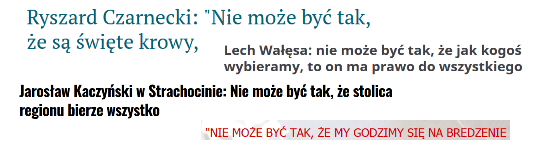
If you listen to Polish politicians on the TV or radio, there’s one expression that they use over and over. No matter which subject they’re discussing – the EU, the budget, the constitution – they introduce their opinion by saying:

Nie może być tak, że…‘ (We can’t accept that…)

nie moze byc tak ze

Basically, they’re saying that whatever situation exists right now, it can’t continue like this. They rarely offer an alternative, but they are good at pointing out exactly what ‘nie może być‘.

The most common sign in Poland has the word ‘zakaz‘ (it’s forbidden to…) written in big capital letters across the top, followed by whatever activity is forbidden – parking, playing ball games, feeding the birds. Even if you don’t understand Polish, it’s very obvious what ‘zakaz‘ means – the sign is usually bright red and often there’s a image showing what’s forbidden.

Curiously, despite the popularity of these expressions, they don’t work.

  • Nie wolno – this is used when someone (often a child) is already doing what’s forbidden. Saying ‘nie wolno‘ won’t stop them, at best it will lead to the response ‘why not?’
  • Nie może być tak, że – whatever subject is being discussed, it will become more popular because now more people know about it.
  • Zakaz – people are already doing this activity in this place – that’s why it was necessary to put up the sign in the first place. Adding the sign just gives people a reminder that this is a good place to park, play ball games, swim etc.

If there’s one thing I’ve learned living in Poland, it’s that despite all these reminders about what people can’t or shouldn’t do, Poles will do it anyway!

So that British guy who heard ‘nie wolno‘ everywhere but didn’t understand what it meant, well, it turns out that he was paying more attention to the expression that most Poles do!


headlines from http://wyborcza.pl/7,75398,21877293,jaroslaw-kaczynski-w-strachocinie-nie-moze-byc-tak-ze-stolica.html; http://www.polsatnews.pl/wiadomosc/2017-08-31/lech-walesa-nie-moze-byc-tak-ze-jak-kogos-wybieramy-to-on-ma-prawo-do-wszystkiego/; https://wpolityce.pl/polityka/342152-ryszard-czarnecki-nie-moze-byc-tak-ze-sa-swiete-krowy-ze-jak-ktos-byl-premierem-i-lgal-jak-najety-to-nie-bedzie-pociagniety-do-odpowiedzialnosci

Diego in Zakopanego

There’s a rumour that Polish is the 3rd hardest language for English speakers to learn. After a few months in Poland, I thought this claim was exaggerated. Sure, the numbers and pronunciation were hard work, but I had managed to pick up quite a few words and expressions. This is not so bad, I thought. But then I started learning Polish grammar!

I was surprised when I learned that Polish has seven cases. I was even more shocked when I learned that nouns and names change depending on the case… as the following anecdote demonstrates:

I was planning to take a trip to the Tatry mountains and went to the railway station to buy a ticket. Of course, I had prepared in advance, using a dictionary and in my pocket was a slip of paper with ‘one ticket please‘ written in Polish (along with a phonetic version so I could pronounce it correctly). I thought it would be a piece of cake.

Me: poproszę jeden bilet do Zakopane

Cashier: do Zakopanego?

Me: Nie, Zakopane.

I’d never heard of Zakopanego and I didn’t want to go there for a long weekend!

The cashier eventually sold me a ticket to Zakopane and I checked it carefully to make sure that I had bought a ticket to ‘Zakopane’ and not some other town with a similar name.

In English we don’t have ‘cases’. A noun doesn’t change in any way. A ‘book’ is always just a ‘book’ It doesn’t matter if you’re giving it to someone, throwing it away or jumping up and down on it. The spelling doesn’t change.

But in Polish…with all these cases…the names of things, people and places keeps changing. It can be very confusing.

It’s especially confusing with names. ‘You mean, you’re not called Piotr when I go somewhere with you? Then you’re Piotrem! And if I buy Piotr a present, it’s not actually for Piotr, but for some guy called Piotra!‘ Sounds a bit schizophrenic to me…all these different identities!

3 Piotrs2

Incidentally, my name is Andrew, but I use the short form ‘Andy’. When Poles use the genitive case (e.g. zadzwoniłem do Andy’ego), then my name becomes ‘Andiego’ which makes me sound Spanish. (By the way, what happens if you want to call a Spanish guy called Diego?).

Once I had got my head around these changes, I realised that I would have to learn them. So I got out my grammar book and some paper and drew a table – all the cases down one axis, all the genders across the top and started to fill it in. As it got longer, I attached another sheet to the first piece of paper. But there were so many exceptions…you didn’t just add -a or -ego. It depended on how the word was spelled in the first place! Eventually, the table covered three sheets of paper and was so full of data that it was practically useless.

I gave up. I decided that if I need any help with Polish grammar, then I’d ask Piotr or Piotra or Piotrem…any of those guys!

Horror Show

My seven favourite Polish words are:

  • dramat (drama)
  • fatalnie (fatal)
  • katastrofa (catastrophe)
  • koszmar (nightmare)
  • makabra (macabre)
  • masakra (massacre)
  • tragedia (tragedy)

These words are incredibly common in Polish. They are used to describe how terrible everyday experience is – the weather, traffic, your workload, relationships etc – not important stuff, just things you encounter every day.

This slideshow requires JavaScript.

I once attended a management training with a group of Polish managers. It was a bit dull and there was lots of listening to do, so for a whole day I counted the frequency of these words during breaks, chats or group discussions. I counted 11 masakras, 4 koszmars, 2 tragedias and 1 dramat. And that was just in one day.

When using these words, Poles exaggerate about how bad things are. I’ve heard many Poles refer to the weather as a massacre (masakra) which is a bit of a stretch. I mean, a ‘massacre’ is when lots of people die…violently! A bit of rain just doesn’t compare.

As a foreigner, I don’t have a feel for which of these words is the worst. Is a koszmar worse than a masakra? If you have one dramat and one katastrofa in a day is that worse than two tradegias? I don’t know, but Poles seems to have a feel for the scale of horror involved.

I’ve come to the conclusion that these words are used in the Polish version of small talk. In the UK, we break the ice with others by making rather meaningless statements about the weather or travel etc. This is called ‘small talk’.

In Poland, small talk looks like this. Imagine two colleagues meeting in the morning at work:

Magda: Ale masakra!
Janusz: Co?
Magda: Godzinę stałem w korkach.
Janusz: To jeszcze nic. Ja stałem półtorej godziny.

Magda: Massacre!
Janusz: What?
Magda: Traffic jams. I was stuck for an hour.
Janusz: That’s nothing. I was stuck for an hour and a half!

The standard opening is to use one of the seven words (especially after the word ‘ale’) to start the conversation. This arouses curiosity and invites the listener to ask what’s so bad. Then you can describe the horror experience. After that, the listener’s role is to find a worse example – as Janusz does in the dialogue above. By the end of the exchange, both parties agree that things are bad, but disagree about which experience is worse.

Ice broken in the Polish way.

Shortcut#1 – Fake it til you Make it

It takes a long time to learn Polish, but if you’re confident enough, you can fake it. The verb to bluff in Polish is blefować, that’s right, it basically the English verb to bluff + ować. That’s what I’m proposing.

Here are three ways you can ‘fake it til you make it’:

1. -ować

A lot of Polish verbs end in -ować, especially those borrowed from other languages:

  • adapt = adaptować
  • decide = decydować
  • flirt = flirtować

I remember laughing out loud when I heard the Polish verb for saving a copy of data in a separate location is ‘backupować’. Perhaps Polish should borrow the grammatical structure as well and use ‘backować up‘:

  • Backowałem ten plik up

or

  • Backowałem ten plik do góry

Okay, maybe not.

Anyway if you don’t know a Polish verb, then just add -ować to the end of an English one. You’ll have a fair chance of being correct.

And if you want to turn the verb into a noun, add -owanie:

  • blefowanie
  • flirtowanie

You’ll need to decide yourself whether to say ‘backowanie up’ or ‘backupowanie’.

2. -ka

shortcuts_jpg

When talking about professions, use the English word for the male role. But remember to add – ka to the end of word if you’re talking about a woman:

  • barmanka
  • biznesmanka
  • wokalistka

Note that it doesn’t matter if the word contains the word ‘man’. Just stick a -ka on the end and it’s transformed into the female gender!

3. -czny / istyczny / -owy

For adjectives, it’s a little harder because there are two possible endings depending on the sound of the word:

  • drastic = drastyczny
  • mystic = mistyczny
  • snobby = snobistyczny

There’s one important exception to this rule: If you’re talking about something trendy, then you need to use ‘-owy‘ instead:

  • cult = kultowy
  • cool = coolowy
  • oldschool = oldschoolowy

If something was trendy but isn’t anymore, then perhaps the ending will change from -owy to -czny / -istyczny, i.e. in the future when cool is no longer cool, then Poles will say ‘coolistyczny‘.

Quirky Polish#2 – Canaries

One of the joys of learning a foreign language is that you come across strange expressions that completely confuse you.

quirky_jpg

I was once driving behind a bus which transported shoppers to and from a out-of-town shopping centre. On the back of the bus was an advert with a bird in a cage and the text ‘no canaries inside‘. I could have overtaken the bus, it was moving a lot slower than my car, but I wanted to work out what on earth the advert meant. If you wanted to encourage people to use your bus service, then why is it an advantage that there are no canaries inside?

My mind raced, going through all the possibilities I could think of:

  • Obviously, it wasn’t literal. If there was a canary inside the bus, then it would be a selling point. No need to stress that there aren’t any.
  • Canaries came from the Canary Islands originally, hence the name. Maybe the advert was selling holidays? Nope, still made no sense.
  • Besides being pets, canaries were used in coal mines to detect poisonous gases – maybe the advert meant that there’s no danger of being intoxicated by fumes in this bus service? Hardly a selling point.
  • The most famous canary I knew was Tweety Bird from the Warner Bros cartoons. Maybe I was Sylvester the cat and I should hunt the bus to the shopping centre? No, that still didn’t fit.

I was confused…completely confused.

Later that day I asked my wife and she explained that a ‘kanar‘ is a plain clothes ticker inspector who rides buses in search of fare-dodgers.

Ah-hah, I finally understood the advert – the bus service was free so there’s no danger of getting caught by any ticket inspectors!

Like a child, I asked lots of Poles why ticket inspectors are called ‘canaries’ but they didn’t know. Someone somewhere probably had a good reason for calling a ticket inspector a ‘canary’ and it caught on. Now it’s part of the language.

And that’s the fun of learning a foreign language. You come across words and expressions that will confuse you, surprise you and amuse you. Just enjoy the ride!

The Polish Language Test

In his Polish history God’s Playground, Norman Davies describes a test used by Polish troops during the 14th century to check whether a suspect was actually Polish:

“Investigations into the Cracovian revolt were assisted by a simple language test. Any suspect who could correctly pronounce ‘soczewica, koło, miele, młyn’ was judged loyal; he who faltered was guilty.”

Norman Davies, God’s Playground, volume 1, p77


Clearly, Polish words are so difficult to pronounce that foreigners can’t even pronounce simple words like wheel or mill correctly.

I actually had to undergo a similar test in a Notary office one day. Before he would notarize the document I was signing (which was in Polish), the notary insisted I read the document aloud to prove that I understood it. I read one sentence and he said ‘stop’. He had heard enough and by pronouncing one sentence correctly, I had passed the test.

tongue twister_jpg

On many occasions, I’ve experienced Poles using a variation on this technique. When they heard that I’m learning Polish, they immediately respond by asking me to repeat a tongue-twister about a beetle in Szczebrzeszyn (W Szczebrzeszynie chrząszcz brzmi w trzcinie). This has happened so often that I’m curious why.

Obviously, it’s difficult and Poles want to challenge a foreigner with some particularly tricky Polish pronunciation.

However, I sometimes wonder if it’s defensive too. Are they saying ‘don’t get so good at Polish that we don’t know you’re foreign anymore!’ and by hearing me fail, they are comforted that only real Poles can say the ridiculously difficult beetle tongue-twister?


False Friend#1 – Ewentualnie

There are some words in different languages that might look the same and sound the same…but they don’t mean the same! That’s why they’re called ‘false friends’.

While learning Polish, I’ve been tricked quite a few times. Here’s one of the worst (because it meant waiting for beer):

Myself and two friends once took an overnight train from Warsaw to Dresden. Before we left the station, the conductor came to our sleeping compartment, checked our tickets and said ‘if you want anything to eat or drink, just come to the last compartment where you can buy snacks, water, juice …’i ewentualnie piwo’.

Our ears pricked up at the word piwo – it was the start of a long weekend and we fancied a beer or two – but what did the conductor mean by ‘ewentualnie piwo‘?

None of us spoke Polish very well and we assumed that ‘ewentualnie‘ means the same as ‘eventually’ in English, meaning ‘after a period of time’ or ‘at the end’.

‘So we can buy beer eventually. What does that mean?’ asked one friend.

‘Maybe it means that we can buy it after a certain time or point in the journey?’ I replied

‘Yeah, they’re probably picking up the beer in Wrocław and we’ll be able to buy some after that,’ another friend agreed.

So we waited a few hours, checking our watches every few minutes and looking out of the window.

‘Any sign of Wrocław?’

‘No, we’re in somewhere called Leszno.’

‘Are they loading beer onto the train?’

‘Can’t see any.’

The journey was agonizingly slow, but finally the train passed through Wrocław and we went to buy three beers.

In a cruel world, there wouldn’t have been any beer left…but the train was quiet that night. Strangely, the beer was from Elbląg and it wasn’t even on the route!

Quirky Polish#1 – Saigon

The beauty of a language is that they evolve – words get attached to meanings and sometimes no one knows why. The expression sticks and every one uses it, but no one questions why it’s used.

That’s one of the joys of learning a foreign language – you come across such curious expressions for stuff.

quirky_jpg.jpg

So here is one of my favourite bizarre Polish expressions:

Saigon

To był kompletny saigon!

Poles use this expression when a situation or place is in a total mess or upheaval, a good English translation would be ‘disaster zone’.

Now there are some expressions that come with a date stamp, you know exactly in which period of history they come from.

Obviously, this expression came into being during the Vietnam War when Saigon wasn’t looking its best. So sometime during the late Sixties or early Seventies when the Vietnam War was in the news, some Poles started using the word and it caught on.

I often hear Poles in their 20’s or 30s using this expression even though they weren’t even born when the Vietnam War took place!

Jokingly I ask them why they haven’t updated the word, i.e. chosen a more freshly bombed out city to describe a messy situation. Why not Bagdad or Grozny? But then again, that probably wouldn’t be a good idea.

If you’re Vietnamese, wouldn’t you find this expression would be a little offensive? Imagine another culture that heard about the destruction of Warsaw during World War II and it became common in that language to use the word ‘Warsaw’ to describe something that is a total mess. ‘The event was a complete Warsaw‘. Not exactly good PR.

First Words

The first 3 words I learned in Polish were:

  1. cześć
  2. żywiec
  3. chodź

I arrived in Poland in February 1998. I knew one Polish word (cześć), and the only famous Poles I had heard of were John Paul II, Zbigniew Boniek and Lech Wałęsa. I didn’t know a thing about Polish culture, history or food. No worries, I thought, I’ll absorb it all on site. It wasn’t as easy as I’d imagined.

Word#1: Cześć

I figured that the best place to pick up Polish is in Poland itself, so I didn’t bother studying beforehand. I did however buy a small phrase book and spent the flight to Warsaw trying to pronounce the greeting ‘cześć. After greeting a Polish person with this word, my plan was to switch to English.

I did notice that the word ‘cześćand ‘Wałęsa’ contained some strange symbols. The ‘e’ had a tail, the ‘l’ had a belt and both the ‘s’ and ‘c’ had little hats. So the Poles like to dress up their letters, I thought. That’s nice…just as long as it’s the same, familiar letters underneath.

In practice, not a single Pole understood my pronunciation of ‘cześć‘ anyway and we switched to English immediately.


Word#2: Żywiec


small beer_jpg

I spent my first evening in Poland with some new work colleagues and we went out for a beer. When it was my turn to buy a round, I approached the bar and asked (in English) for three beers. The barman responded by asking ‘Żywiec?”

I quickly discovered that Polish beer was good but that it was a challenge ordering it. In fact, it took me three months just to learn how to pronounce the name ‘Żywiec’. As soon as my anglo-saxon mind stared at those 6 letters, there was no way to even begin saying the name. And course, as hard as I tried to memorize it, the effect of the beer washed away the memory and by the next morning I was back to square one. I knew some British guys who drank ‘Lech’ just because it was easier to pronounce!


Word#3: Chodź

On day 2 I went for a walk. Walking down the street, I saw a dog walker turn to their dog who was busy sniffing in the bushes and say ‘chodź‘. The dog immediately looked up and ran over to its owner. ‘Ah-hah I said to myself, ‘chodź‘ must be the name of the dog’. In fact, it seemed to be the most popular name for a dog in Poland, like ‘rover’ or ‘spot’ in the Anglo-Saxon world. Most dog owners were using it. For a time I used to think that the most popular name for a dog in Poland was ‘chodź’. Then I heard some owners using a longer version of the name: ‘chodź tu’, and I was confused. After some hard thinking I deduced two possibilities – either ‘chodź’ was a shorter version of ‘chodź tu’, a little like Bob being short version of Robert – or that this owner had previously owned a dog called ‘chodź‘ who had died tragically and then bought a new dog whom they had christened ‘chodź two’. The next dog would probably be called ‘chodź three’…

So that was my start in learning Polish – two words I couldn’t pronounce and a third I didn’t understand. Perhaps it wasn’t going to be so easy.