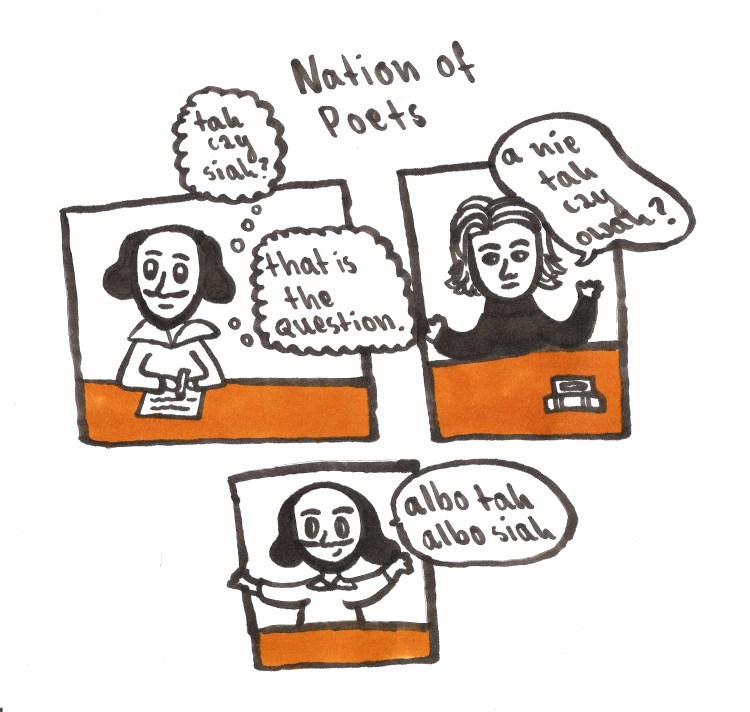
Nation of Poets#2 – Geography

Poles use a lot of rhyming expressions in everyday speech. The most famous is ‘smigus dyngus‘ – a rhyming name that sounds silly, but which actually fits well with the type of activity it describes!

I once told a friend that I like these rhyming expressions in Polish and he said:

What can I say? We’re a nation of poets!

So to celebrate this nation of poets, here are some of my favourites. This week two expressions that include cities / countries:

Jedno oko na Maroko, a drugie na Krym

nation2

What an excellent example of Polish poetry – using a rhyme to describe a physical feature, in this case, a squint (zez), i.e. one of the eyes looks west towards Maroko, while the other looks east towards Crimea.

Now this is quite a squint with both eyes looking very far apart. I wonder if Polish allows for smaller differences, i.e. jedno oko na Monako, a drugie na Kijów? Monaco isn’t as far west as Maroko so this would describe someone whose eyes are only slightly out of alignment.

Actually, just thinking about this idiom gives me a squint (see Shakespeare above).

Życie jak w Madrycie

Literally, this means ‘life like in Madrid‘ and describes a lifestyle that is fun and luxurious. To me, this is one example in which Poles have chosen a city that rhymes over a city that has an especially vibrant lifestyle. I mean ‘life in Paris or Rome‘ might have been better choices, but they don’t rhyme with życie.

All in all, this expression is great PR for Madrid, and I wonder whether any Poles have taken a holiday in Madrid just because they anticipated a fantastic nightlife? Perhaps the expression was created by a Spanish marketing agency to build a positive image about the Spanish capital?

With that in mind, I can imagine a Polish tourist agency trying to do the same thing by creating a rhyming idiom about a town or city in Poland:

  • Get it on in Ustroń
  • Party hard in Nowy Targ
  • Oh-la-la Dukla
  • Live in up in Gołdap
  • If it’s in, it’s Ryn
  • You and I, Biłgoraj
  • Run amok in Sanok
  • The nights are long in Elbląg
  • Live a lot in Sopot
  • Woo-woo Łódź
  • Shake your bun in Wieluń
  • Make a Wish, Przasnysz

If ‘live it up in Gołdap‘ became a common expression in English, then the tourist industry in the town of Gołdap would clearly receive a significant boost. Or if ‘You and I, Biłgoraj‘ was included in the Cambridge dictionary, then perhaps Biłgoraj would become a honeymoon destination like Paris or Niagara Falls. Or if ‘Make a Wish, Przasnysz‘ went viral, then maybe the next Disney theme park would be built in Mazowsze.

Imagine that!

Third Time Lucky

I once thought that if I stopped making mistakes, then my Polish would be better.

I employed a teacher for 1-2-1 lessons. At our first meeting, I told the teacher that if I made a mistake, she should interrupt immediately and correct me. She agreed and we started talking in Polish. I said two words, she stopped me and corrected me. I repeated the first two words again – this time correctly – and added a third word. She said stop, corrected me again… and so it went. It took ten minutes for me to finish the first sentence.

Hmm…I thought… maybe it was a mistake to try avoiding making mistakes. Were mistakes so bad? I had certainly made some good ones!

trzech_jpg

The first time I was invited for dinner in Poland, I wanted to buy some wine to give to my host. No problem, I knew the Polish word for wine was ‘wino‘, I just needed to know the word for dry and white so that I could buy some dry, white wine. I opened my English-Polish dictionary. White was biała and dry was suchy. I made a note on a scrap of paper – suchy biała wino.

I walked to local shop, took out my note and asked for suchy biala wino. The shop owner looked at me strangely.

„Białe wino…a wytrawne, półwytrawne, słodkie?

I switched to my standard emergency response ‘Nie rozumiem‘. He took down two bottles off the shelf. One said wytrawne, while the other was półwytrawne. Either wytrawne meant dry or sweet and pół probably meant ‘un-‘. I gambled that it meant sweet and bought półwytrawne.

I learned three things from this experience. One, that wine in Poland is wytrawne or słodkie. Two, that wytrawne means dry. And three that using a dictionary isn’t as simple as I thought.

Another time I was running a training session for a group of around 30 Poles. Holding up a clipboard, I asked if everyone had their podpaski (sanitary pads) so that they could make notes. The entire group burst into laughter. That was very powerful and immediate feedback. Ah-hah, I thought, I’ve used the wrong word and whatever it means, it’s pretty funny.

And one time, I used the verb to kiss (całować) rather than the verb to regret (załować). Instead of saying sorry and regretting what I’d done, I embraced my inappropriate actions by saying I wanted to kiss them.

Indeed, the more embarrassing the mistake, the more powerful the learning experience. There are load of Polish words I’ve learned because I got them wrong the first time.

I ended the 121 lessons after one meeting. I thought that if I stopped making mistakes, then my Polish would be better. But in the end I realised that if I stop making mistakes, my experience of learning Polish would be poorer….much much poorer.

English and Polish share an idiom – third-time lucky / do trzech razy sztuka – that sums up the process of learning through mistakes. In many cases, especially in language learning, you need to fail twice if you want to succeed the third time.

Quirky Polish#2 – Canaries

One of the joys of learning a foreign language is that you come across strange expressions that completely confuse you.

quirky_jpg

I was once driving behind a bus which transported shoppers to and from a out-of-town shopping centre. On the back of the bus was an advert with a bird in a cage and the text ‘no canaries inside‘. I could have overtaken the bus, it was moving a lot slower than my car, but I wanted to work out what on earth the advert meant. If you wanted to encourage people to use your bus service, then why is it an advantage that there are no canaries inside?

My mind raced, going through all the possibilities I could think of:

  • Obviously, it wasn’t literal. If there was a canary inside the bus, then it would be a selling point. No need to stress that there aren’t any.
  • Canaries came from the Canary Islands originally, hence the name. Maybe the advert was selling holidays? Nope, still made no sense.
  • Besides being pets, canaries were used in coal mines to detect poisonous gases – maybe the advert meant that there’s no danger of being intoxicated by fumes in this bus service? Hardly a selling point.
  • The most famous canary I knew was Tweety Bird from the Warner Bros cartoons. Maybe I was Sylvester the cat and I should hunt the bus to the shopping centre? No, that still didn’t fit.

I was confused…completely confused.

Later that day I asked my wife and she explained that a ‘kanar‘ is a plain clothes ticker inspector who rides buses in search of fare-dodgers.

Ah-hah, I finally understood the advert – the bus service was free so there’s no danger of getting caught by any ticket inspectors!

Like a child, I asked lots of Poles why ticket inspectors are called ‘canaries’ but they didn’t know. Someone somewhere probably had a good reason for calling a ticket inspector a ‘canary’ and it caught on. Now it’s part of the language.

And that’s the fun of learning a foreign language. You come across words and expressions that will confuse you, surprise you and amuse you. Just enjoy the ride!

Nation of Poets#1

poets_jpg


Poles use a lot of rhyming expressions in everyday speech. The most famous is smigus dyngus – a rhyming name that sounds silly, but which actually fits well with the type of activity it describes!

I once told a friend that I like these rhyming expressions in Polish and he said:

‘What can I say? We’re a nation of poets!’

So to celebrate this nation of poets, here are some of my favourites:

Ryzyk Fizyk

This means well, it’s worth taking the chance.

It’s actually quite persuasive when someone says this. Including the word ‘fizyk/physics’ suggests that we’re not talking about ‘chance’ but the mechanical laws of the universe!

It was probably coined by Kopernik when the church were considering publishing his research!

Tak Czy Siak

  • tak czy siak
  • tak czy owak
  • albo tak, albo siak

These expressions mean ‘in any case, anyway or for better or worse. The rhyming works well to express that we’re talking about something that doesn’t matter.

What is a ‘siak’ anyway? Whatever it is, it similar to an ‘owak’ and it’s always an option. If you don’t like the first option, there’s always the ‘siak’ option.

In Chinese, the word tao means ‘way’ or ‘route’ and signifies the path to spiritual enlightenment in Taoism. For a Polish equivalent, then I offer you Siakism or Siakizm. If you are in two minds, then choose the way of Siak – it might not be a well-trodden path, but hey ‘ryzyk fizyk!’

Prosto z Mostu

Literally, ‘straight from the bridge‘. When I first heard this expression, I assumed it described having ‘first hand’ information about something – as if to get the best view of what’s happening, you should go and stand on the bridge! This made sense to me because the idiom does mention a specific location.

However, I learned that it actually means ‘bluntly’ and describes a communication style that is very direct or even rude.

As locations go, I wouldn’t describe the bridge as being the most vulgar. The sewer or the gutter maybe, but the bridge?