Combine Harvester

When you’re learning a foreign language, you tend to learn one word or expression at a time. There are some words that you can learn in a few minutes, some require repetition over a few days, and some words take years to learn.

That’s how it was with kombinować. It took me years to fully understand what it meant.

At first, I thought it was a no-brainer. Yep, that’ll be the Polish version of ‘to combine’. Easy-peasy.

But in practice, no one ever said what two things were being combined. They just said on coś kombinuje, and in my head I was thinking combine what with what? As a beginner, it’s rude to correct a native-speaker of a language, but I felt like correcting Poles by asking ‘doesn’t that verb need an object, well actually, at least two objects?

I bit my tongue and decided to do some research instead. My pocket dictionary translated kombinować as ‘to wangle’. I hate it when you check the meaning of a word, but you don’t understand the translation into your own language. Wangle, what does wangle mean? No one ever wangles where I come from!

Fortunately, the dictionary also translated the expression on coś kombinuje as ‘he’s up to something’. Okay, I thought, so it’s negative and means that someone is trying to hide their true intentions in order to achieve something.

But, one day when we were driving around looking for a parking space, a friend said ‘coś wykombinujemy‘ and parked the car on the pavement between a lamp post and a bus stop. He wasn’t suggesting we enter into a conspiracy or try to hide anything. To my ears, it sounded like he was saying ‘let’s try something creative’. So kombinować had a positive meaning as well, especially if you add wy- at the beginning.

Just when I thought I was getting to grips with kombinować, next up was kombinator. Oh great, not only do I need to work out what the verb means, there’s a noun as well!

To foreign ears, kombinator sounds like a profession in the engineering sector. There’s a branch of mathematics called ‘combinatorial analysis’, and I imagined some Wyższa Szkoła Kombinowania where you study for years to master the science behind kombinowanie.

As far as I could tell, kombinować can be positive or negative depending on the context, but it seemed that calling someone a kombinator was always derogatory. If you took the kombinowanie too far, then you crossed a line and became a kombinator. But what was the deciding factor? Does a kombinator need to break a law, infringe on others’ interests, or simply do it too frequently?

And how to translate kombinator? The best English equivalent is wheeler-dealer from the idiomatic expression to ‘wheel and deal’. Most people associate this with selling used cars, a business activity that certainly offers plenty of scope for kombinowanie.

The more I encountered this word, the broader its meaning became. The more dictionaries I checked, the more possible translations – be up to no good, deceive, contrive, scheme, figure something out, work an angle, fiddle, hustle, wheel and deal, get creative, juggle, try something, conspire, live on one’s wits! And every dictionary gives a different set of translations – I must admit that I’ve never seen such variation in the translation of a single verb. The publishers of English-Polish dictionaries should hold a conference just to agree one set of possible translations…and see if they can narrow it down to four or five English options!

I began to realise that kombinowanie is no ordinary word describing an ordinary activity. It’s part of something deeper, more significant to Polish culture. It’s something of a skill – a problem-solving ability that Poles are particularly good at. The only way to really understand what kombinować means is to observe Poles in action over a number of years, example after example, context after context.

And that’s what I did.

One of my favourite examples of kombinowanie that I’ve observed concerns a removal company. I once employed a guy to move some furniture and actually traveled with him from city to city. He was bald, unshaven and permanently wore a bluetooth headset in each ear which made him look like a pirate. He had two mobile phones and explained that he had two sim cards in each one. He advertised as four different removal firms with four different numbers. When a client called and asked for a price, he would quote a high figure. When the client called him again, thinking they were calling a different firm, he would change his voice and quote an even higher figure. The client, assuming they had shopped around and found the best price, would call back and hire the first firm.

Genius!
oscar

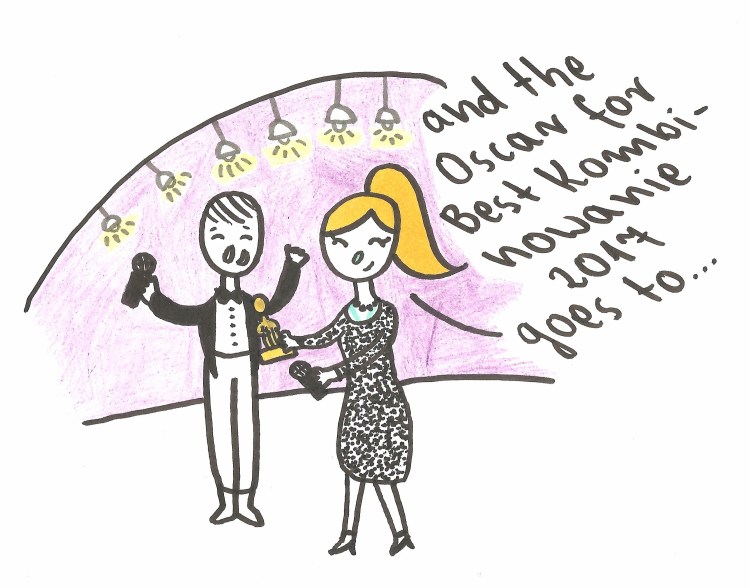
There’s a lot of creativity in kombinowanie. If there were Oscars for the best global examples, then Poles would win every year!

Of course, in this Oscar category, Poles would have one huge, unfair advantage – only they’d know what the word kombinować actually means!
Lessons from Traffic Cops

Once when I was driving through the Polish countryside, I didn’t slow down when passing through a tiny village. From nowhere, a policeman stepped onto the road and signaled for me to pull over.

It was the first time I had ever been stopped for speeding in Poland.

I’d heard lots of stories from Poles that you could get away with speeding by offering a small bribe to the policeman. Indeed, I knew one Polish sales representative who used to carry lots of promotional gadgets in the boot of his car and would offer them to traffic police whenever he got stopped.

But I had grown up in the UK where bribery is extremely uncommon – in fact, I’d never bribed anyone in my entire life – and honestly, I didn’t even know how to do it!

So as I walked over to the police car, I was full of doubts. How is this going to work? Am I supposed to make an offer? Can I haggle? Should I start straight away or wait until he goes through the formal procedure? But what if I try to bribe him and he arrests me!

Also, linguistically, bribery is a hard interaction to master. It’s based on lots of subtle words and expressions that dance around the topic so as not to make it explicit. At the time, my Polish was pretty basic and certainly not good enough to be clever. Indeed, in the stress of the moment, I’d even forgotten the polish word for bribe!

You were going pretty fast,’ the policeman said to start the conversation.

Yes‘, I replied, not wanting to deny it.

This is a built-up area. The speed limit is 50 kilometres per hour.’

I know.

And you were doing over 70...’ and he showed me the figure 73 on the radar he was carrying.

Sorry,’ I said and tried to look as if I’d just learned the biggest lesson of my life.

He paused for a moment.

It’s going to happen now, I thought. He’s established the facts, now he’s moving on to the resolution. Now he’s going to raise this very delicate topic of bribery. Get ready…

How about a warning (to może wystarczy ostrzeżenie)?‘ he said.

I’d never heard the word ostrzeżenie before and had no idea what it meant. But, blinded by my expectations, I wrongly assumed it was connected to bribery.

Play it cool, I said to myself. Try and pretend you know what you’re doing. I assumed that I would need to make an offer, but I had no idea what the going rate was. And what was worse, he probably knew that and would see it as an opportunity to take advantage.

So I decided to put the ball in his court.

How much does that cost?‘ I replied.

The policeman looked puzzled and slid his cap back on his head. Whoops, I thought, that surprised him. Maybe it’s his first time too?

Nothing!‘ he said.

Oh, right. I understand,’ I mumbled…even though I had no idea what just happened.

I walked quickly back to the car, still wondering what ostrzeżenie meant.

police2

Some foreigners, when they are stopped for speeding, speak in English only, hoping that the police will give up in frustration. However, on the two occasions that I have been pulled over, I interacted with the police in Polish and they seemed to appreciate that a foreigner was at least trying to speak their language. I also learned some new expressions too.

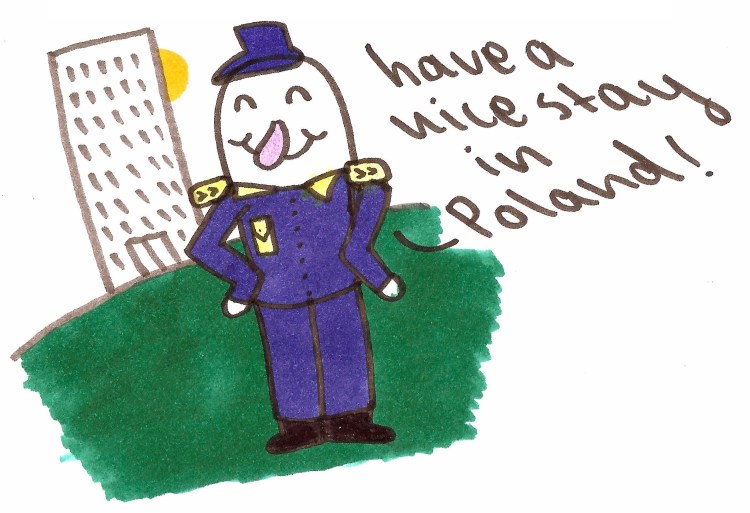
As well as the Polish word for warning, I also learned the phrase ‘życzę miłego pobytu w naszym kraju‘ from a traffic cop.

The second time I got stopped, the policemen asked me where I was from, and it turned out his brother was working as a policeman in Scotland not far from my home town. At the end of the conversation, he told me to drive more slowly (fulfilling his duty as a policeman) but also wished me a pleasant stay in Poland.

Despite these two lessons, there are definitely more responsible ways to learn Polish, so I stick to the speed limit. I don’t want to push my luck, otherwise, the next time I might end up learning words like mandat or punkty karne!

Imperial Delusions

My first flat in Poland looked over a bunch of ramshackle huts arranged in rows. I asked my landlord what it was and he said it was a bazaar.

Being British, I grew up hearing and reading tales about our former empire. The adventures of British explorers, soldiers and administrators are popular and describe a world full of strange lands, exotic peoples and quirky cultures. It might be a bit misleading in the 21st century, but I was taught to associate foreign lands with Kipling’s the Jungle Book, the Arabian Nights and the search up the Zambezi river for Dr Livingstone.

So when I heard that there was a bazaar next to my block, my mind raced to ancient Persia, flying carpets and Ali Baba.

When you go to a foreign country, you expect things to be unfamiliar. Yet sometimes, those expectations can go too far and you discover that reality isn’t quite as weird as your own imagination.

So assuming that a Polish bazar was not unlike an Arabian bazaar, I decided to play it safe. For about a month I didn’t go anywhere near it just in case I got tricked out of all my zloties by a snake charmer.

When I finally did venture into the bazar, with my camera ready, it was a great disappointment. There were no oriental silks, no fortune-tellers, and no persistent camel salesmen – just lots of market stalls selling vegetables, shoes and pirated Cds.

No Ali Baba, only Ali Babcia!

pavilion

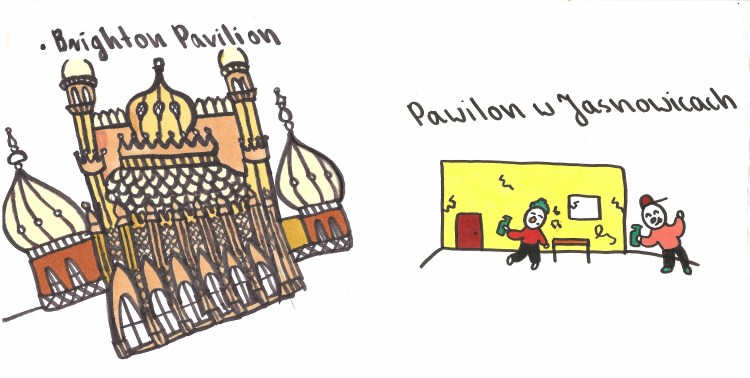
Another time, a friend suggested we meet at 7pm ‘by the pavilion next to the park‘. I showed up an hour late!

Why? Because I was looking through my imperial lenses again. Because I was looking for a fancy, exotic-looking building near the park. You see, in English, a pavilion is an elegant, often historic building that is used for leisure activities. In Brighton there’s an ornate building called the Royal Pavilion with domes and minarets that was modeled on Indian and Muslim architecture.

So for an hour I wandered around the park, like Livingstone in Africa, looking for splendid neo-colonial palace.

With this goal in mind, I completely overlooked the squat, flat-roofed building in one corner of the park. Whatever that was, it wasn’t a pavilion.

Eventually, I called my friend and she explained it was at the west side of the park. I went to the west-side. Still couldn’t find a pavilion. Called again, asking for more directions. In the end, we had to stay connected while my friend guided me to the pavilion as if I were blind.

I soon learned that in Poland a pawilon isn’t very exotic at all. It just a type of shopping centre in the middle of a housing estate. Just a glass-fronted, concrete box where the local chemists, grocery shops and dry-cleaners are.

No minarets, only mini-markets.

So for a while my colonial imagination confused me a little in Poland, and it took a while to calibrate my expectations to reality.

Yet language also played a part. It was the names given to particular places and buildings that gave me the wrong impression:

  • A galeria doesn’t exhibit paintings?
  • A bar mleczny doesn’t sell milkshakes?
  • and a pasaż doesn’t go anywhere?

If they’d just used dom handlowy instead of pawilon, I might have recognized it at once!

Oh and besides not getting used to its architectural appearance, I couldn’t get the pronunciation of pawilon right either.

To this day, I still say ‘pavilion’ instead of ‘pawilon‘ … for some reason, I just can’t get my tongue to make the switch.

So whenever I pop out to buy some bread or potatoes, there’s a part of me that thinks it’s in India, riding an elephant through a sea of natives towards the gleaming marble domes of an exotic, colonial palace.

Driving into Town

When you live in a country but don’t fully understand the language, there are times when you can’t tell the difference between a word and a name.

Take for instance, the first time I went sailing in Mazury. In the late afternoon, the rest of the crew would discuss in which port we would spend the night: ‘We could stay in Mikołajki, or go back to Wierzba or there’s always Trzcina.’ During the trip, I was surprised that Trzcina was always an option – whether we were in the northern lakes or down in the south. ‘Wherever this port of Trzcina is,’ I thought, ‘it must be pretty central because it’s only a couple of hours sailing from anywhere in the Masurian Lakes!’

It’s no different on the road.

In the same way that I thought Trzcina (reeds) was a port, a foreigner coming to Poland for the first time might think that Wita is name of a town in Poland. I’ve seen quite a few road signs on which the word Wita is printed in a bigger, bolder font that the actual place name.

Either that or a foreigner might think that Wita is another word to define a town like Dolny or Wielki. ‘We didn’t get much of a welcome in Olsztyn Wita so why don’t we look for some accommodation in Olsztyn instead?

Indeed, this is part of a wider issue for a non-native learner – in the final kilometre before any Polish town there are so many billboards, welcome signs, banners and advertisements that you can be overwhelmed.

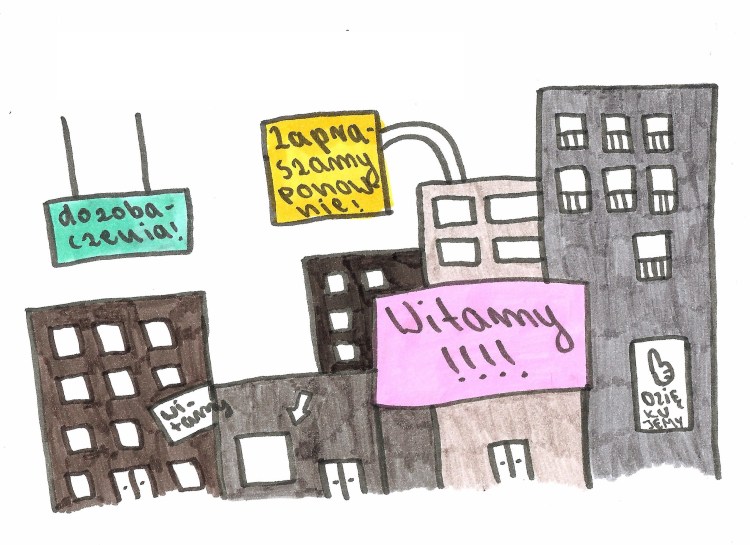
So to help, I’ve prepared this short guide to arriving or leaving a Polish town:

Arriving

  • wita / witamy = either the town (wita) or its people (witamy) are welcoming you. Personally, I’ve always felt that witamy is a warmer version because it comes from the people. How exactly a town can welcome anyone I’ve never figured out.
  • zaprasza / zapraszamy = in this case, either the town or its inhabitants are inviting you over, but don’t worry, you are not expected to bring a gift.
  • miasto monitorowane = this literally means that the town uses surveillance equipment and often comes right after the witamy sign. Together these signs mean, ‘you’re welcome, but keep your hands where we can see them!’. Basically, the authorities don’t trust you not to break the law as you pass through.
  • warto zobaczyć – this presents three things that are worth seeing in the town. Always disregard the last one, it’s just there to make up the numbers.
  • witamy na ziemi…/ ziemia…wita = often a region or jurisdiction will welcome you, e.g. witamy na ziemi świętokrzyskiej. Foreigners might panic at first, thinking this is a message for aliens, welcoming them to the Planet Earth. Don’t worry, it just means ‘welcome to the land of…
  • miasta partnerskie – these are other places with which this town is twinned. If you’ve never heard of any of the towns mentioned, don’t worry, no one has!
  • EU Funds – finally, you might see something that looks more like an enlarged document than a street sign. You can ignore this, it’s just a receipt showing who paid for the pavement.

One challenge with these signs is that they tend to be covered in graffiti, so you might not know which town you’re in, but you will know which football team is trending.

Leaving

It’s the same story when you’re leaving town. Quite wisely, most towns don’t invest too much effort to say goodbye, however, there are some things it’s worth bearing in mind:

  • żegna / żegnamy – to me, this is more personal than do zobaczenia, especially żegnamy. However, if the town welcomed you on the way in (wita), but the people are saying goodbye (żegnamy), then it means that they’re glad to be rid of you.
  • zapraszamy ponownie – the townsfolk are inviting you back. However, if you noticed a miasta monitorowane sign on the way in and you broke a few driving laws, then I wouldn’t go back if I were you.
  • termination sign – in Poland, when leaving a town, there is a sign showing the town’s name with a red line through it. This looks very official as if the town just got cancelled by some bureaucracy. Don’t worry, the town will continue to exist, just not for you. We don’t have such signs in the UK. You just drive out of town without any fanfare. In Polish, there’s an idiom wyjść po angielsku (to leave in an English way) which means to ‘leave without saying goodbye to anyone‘. The same applies to towns and villages in the UK – they don’t say goodbye either.

Radom wita

Billboards & Banners

Finally, a word about billboards and banners. Polish towns extend a warm welcome, but their businesses welcome you and your wallet even more warmly. I must admit that there are so many billboards and banners lining the road into most places that I wonder whether there is a legal requirement, i.e. to register a business, you are obliged to erect a ugly billboard or sign on the road into town.

It seems that, in Poland, if you’re setting up a business, then you don’t have many choices for the company’s name. In fact, there are only 3 options:

1. -pol

The first option is patriotic. You use the suffix -pol to show the world that your business is 100% Polish. This is especially true if you sell food:

  • Szynkopol
  • Indykpol
  • Rybopol

For a logo, it’s common to use a cartoon of a pig, turkey, fish etc, happily dancing its way to the dinner table.

2. -ex / -bud

The second option is for a company that exports a product or service. In this case, it’s necessary to add -ex to the end of the name. The owners hope, rather optimistically, that this gives the company an international profile:

  • Dachmex
  • Żwirex
  • Paletex

The only exception is the construction industry, then it’s necessary to use bud in part of the name:

  • Drogbud
  • Słupbud

3. Two Guys

The final option is used if two Polish guys are setting up in business together. In this case you take one syllable from each of their first names and join them together:

  • Janmat = Janusz and Mateusz
  • Zendar = Zenon and Dariusz
  • Jarmar = Jarosław and Mariusz

To give another example, there’s a furniture company that operates in Poland called Juan. Because of the name, I assumed it was Spanish, but I later learned that it was set up by two guys from Warsaw called Jurek and Andrzej. Stupid me, forgot about the two guys rule!

If you are bored on a long journey, then you can play a game with these company names. It’s a great way to pass the time.

The rules are simple. The first passenger to spot a sign, billboard or banner with one of the above types of company names get the points. As you leave town, the person with the most points wins.

  • -pol = 1 point +  2 additional points if there’s a dancing turkey, fish, pig as a logo
  • -ex/bud = 2 points
  • two guys = 3 points (but you have to say which two names were used)

By the way, if you’re playing this for the first time, avoid Radom, it’s for advanced players only – you’ll have 30+ points before you get anywhere near the city!

The Alphabet Enigma

Ask a British person how many letters there are in the alphabet and they will instantly answer: twenty-six.

Ask a Polish person how many letters are in the Polish alphabet and they don’t know. Indeed, they don’t even care. The most typical responses are:

  • who cares?
  • never counted!
  • why would I need to know that?

In Britain everybody knows some basic facts – there’s 1 sun in the sky, 4 points on a compass, 12 months in a year, and the first thing you learn on your first day at school is that there are 26 letters in the alphabet.

In Poland, no seems to give a damn how many letters there are.

It’s weird, shocking, even scandalous, and whenever I express this to a Pole, they don’t see the problem.

Without knowing how many letters are in the language, how can you type an email, decode the enigma machine or do something really hard, like play Scrabble?

I guess part of my shock is connected with the fact that I, as a foreigner learning Polish, had to get to grips with many additional letters. Yet Poles don’t even know how many there are!

Another enigma that surrounds the Polish alphabet are the phantom letters Q, V and X. They’re not in the language, but they show up from time to time and this confuses me.

V, for instance, isn’t in the written language, but does exist in body language – I’ve seen many Poles holding up two fingers to show the V for victory gesture. Is this allowed? V isn’t even in the Polish alphabet. Shouldn’t they make a Z for zwycięstwo gesture by drawing a Z in the air… or would people think they’re referring to Zorro?

Then, there’s X which appears in the names of countless Polish firms from Budimex to Metalex, while Q is present in Latin words such as Quo Vadis. So do the letters Q, V and X exist, or don’t they?

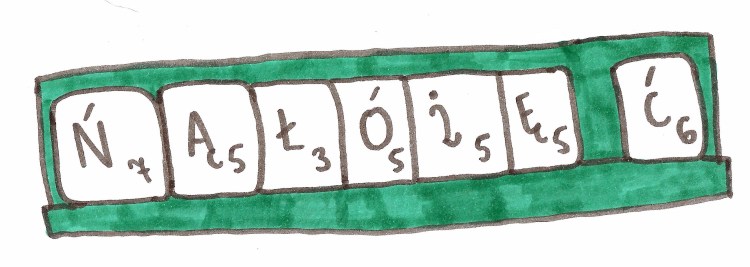
Foolishly, I once agreed to play Scrabble in Polish. An English native-speaker gets a surprise straight out of the box when you see the points on the letter tiles. In the English version, Z is worth 10 points while in the Polish version it’s only worth 1. The other most valuable letter in English is Q, which is worth 10, but isn’t in the Polish version. My usual strategy for winning – waiting until I can place the word q-u-i-z on a triple word score – just wasn’t going to work.

scrabble

So I started with a short, simple word – just three letters J, U and Z to spell the Polish word for ‘soon‘:

Me: It’s on a triple word score, so 3 times 6 equals 18 points.

Opponent: There’s no such word, już is spelt with a Ż.

Me: Aren’t the Z’s interchangeable? I don’t have a Z with a dot.

Opponent: No, they’re completely different letters. One is worth 1 point while the other is worth 5.

Me: Oh come on. That’s pedantic. It’s the same letter. Looks the same, sounds the same and comes at the end of the alphabet.

Opponent: No, Z, Ż and Ź are different letters entirely.

Me: But I’m a foreigner, isn’t there’s some handicap system in which I can substitute a normal Z, S or C for the funny ones?

Opponent: No. They’re different letters. You can’t substitute a M for a W by turning it upside down!

Me: Fine, can I have ‘F-U-J?

Opponent: No, it’s not a word.

Me: Of course it is. That’s what foreigners say when they first see the Polish alphabet!

Okay I was being facetious – they look so cute that learners, when they first encounter the new letters, give them special names:

  • funny E
  • Z with a hat
  • A with a tail
  • L with a belt

I guess it’s because they look like Roman letters dressed up in Polish folk costumes with hats, belts, swords and feathers.

In Polish, some of the diacritical marks are called kropki and kreski (dots and dashes), and of course, dots and dashes are also found in Morse code…

…which makes me wonder…

…maybe Polish writing actually contains a hidden code?

Maybe thousands of encrypted messages are hidden in all those dots and dashes and funny tails?

I don’t want to sound paranoid, but what if the sentence ‘Czy świerszcze lubią jeździć na łyżwach?’ includes a hidden message to Polish readers, like ‘never let a foreigner beat you at Scrabble‘?

Just before World War II, when the Polish Army shared their intelligence on the Enigma machine with their British and French allies, did they share everything, or perhaps, did they keep something back?

Just like the number of letters in the Polish alphabet, and the phantom letters Q, V and X… it’s an enigma!

Far, Far Away

To a child, sitting in the backseat of a car, the most important question is ‘how much further is it?‘ You can’t blame them for asking – Polish fairy tales often start with za siedmioma górami, za siedmioma rzekami… (over seven mountains, over seven rivers…), which builds the expectation that most places are pretty far away.

From an early age, we need to know how near or far something is… it’s no wonder that a language develops a rich set of words to describe such things.

Near

In English, travel agents promote hotels in holiday resorts by saying they are only ‘a stone’s throw‘ from the beach. And this is something you can check. Just walk out of the hotel, pick up a medium-sized stone and try to throw it as far as the beach. Of course, your hotel will only be a stone’s throw away from the police station if you injure someone, but if no one is around, then you can actually verify the advertising.

The equivalent expression in Polish – rzut beretem – intrigues me. If you want to say that something is close by, then why say it’s only a beret’s throw away? I assume you would have to toss the beret as if it were a Frisbee, otherwise it wouldn’t go very far. But why a beret? I guess you can throw a beret further than a woolly hat, but why choose headgear in the first place?

I’ve never associated the beret with Poland. It’s more commonly associated with France. Maybe this idiom is anti-French? Do Poles like to tease the French by throwing away their headgear? Is that why Napoleon didn’t hang around in Poland very long – because Maria Walewska kept throwing his funny hat out of the palace window?

A better hat would be those worn in Zakopane – I’m sure you could throw a ‘kapelusz góralski‘ quite far off the top of Giewont.

For advertising purposes, the expression rzut beretem is perfect if you’re promoting a hotel in the south of France. Saying the beach is only a beret’s throw away fits the cultural context. But it wouldn’t make any sense in Morocco where you would need to throw a fez and your hotel would need to be right on the beach to have any chance of hitting it.

Far

When you learn a foreign language sometimes you get jealous. You come across a word, expression or idiom that is so cool, poetic or funny that you wish you had it in your own language too. That’s how I feel about the following expressions – I wish we had them in English!

Both of them describe a far away backwoods, and they’re so much more poetic than in the middle of nowhere, boondocks or hinterland. There’s a children’s book called ‘Where the Wild Things Are’ and these two expressions seem to fit into that world.

Tam gdzie diabeł mówi dobranoc (out where the devil says goodnight) – this one is really creepy. I mean, if the devil was saying good morning or good afternoon, it would be scary, but the fact that he’s saying goodnight makes it especially dark… as if you wouldn’t want to visit that place because you don’t know whether you’d wake up the next day. I can just imagine the devil saying ‘night, night‘… and adding sarcastically… ‘don’t let the bed bugs bite‘.

devil3

At least the devil is polite enough to say goodnight… in person. You’d think a busy executive like the devil would delegate the job by sending some minor demon to wish you sweet dreams. But no, wherever this place is, it’s important enough that the devil gives it his personal attention.

Tam gdzie wrony zawracają (out where the crows turn back) – while the diabeł expression seems to increase the importance of the place, this expression makes it so unattractive that crows don’t even bother to fly there.

I love the implicit insult in this expression. Crows consume rubbish and carrion, but not even a crow would visit this place to scavenge. When I steal this expression, package it and export it to the UK, I’ll substitute seagulls for crows – they’re more numerous and even less fussy about what they eat… so the insult will sting even more!

But then again, by replacing crows with seagulls, the idiom would lose some of its darkness. After all, crows are associated with death, and if they turn back, what horrors must exist beyond that point?

So, in actual fact, I don’t need a fairy tale or holiday brochure to transport me to a far away place… that’s over seven hills… and over seven rivers.

When it includes the above expressions… all I need to is have a conversation in Polish!

Cute Overload

I have one inhibition when speaking Polish.

It’s not that I’m concerned with making grammar mistakes. I don’t care if I get vocabulary mixed up. And it’s not about using the right declination.

The thing that I have a big inhibition about…is diminutives!

I just don’t feel comfortable speaking in a way that makes things small and cute.

The Polish language has a lot of tricky grammar, but one, often overlooked, challenge for learners is grasping diminutives. By saying kawka instead of kawa (coffee) or piesek instead of pies (dog), Poles have special ways of making things sound small, cute and fluffy.

There’s a website called Cute Overload – it’s just pictures of cats, dogs and other sweet animals. If you need a daily fix, this is the place to go. And sometimes that’s what Polish sounds like…cute overload!

Take for example the word kot. Now I do think that cats are pretty…but does Polish really need 15 words to talk about a cute cat?

9 cats

kot, kotek, koteczek, kotulek, kotuś, kocurek, kociak, kociaczek, kocię, kociątko, kicia, kiciulek, kiciuś, kocisko, kocur

In English we survive with just two cutesy words for cat, namely kitty and pussycat, but Poles either really like cats or no one is heartless enough to trim the dictionary.

I ask Polish friends to explain all of this, but it rarely helps:

Me: What’s the difference between kot, kocurek and kiciuś?

Pole: Well, a kocurek is a small, cute and fluffy cat.

Me: And a kiciuś?

Pole: It’s even smaller and more fluffy.

Me: Cuter too?

Pole: Oh yes.

There are so many words for cat that sometimes I get confused and think any word that starts with a ‘k’ is another kitty word. Kościuszko…is that the guy who lead an uprising in the 18th century or is it just another word for a pretty cat?

Polish kids learn all this language during the first few years of their lives. Foreigners, who try to learn Polish grammatical rules, have a harder time. Indeed, if you try and organize all the cat words into a sensible order, you end up with a table that even Mendeleev would struggle to understand:

table

And as a result of internet memes, there’s even a new addition: koteł. Will the list ever stop growing?

So coming back to my inhibitions, I’m actually okay using diminutives when referring to kittens, puppies and froggies, but I have a harder time when it comes to non-living things – kawka, herbatka, łyżeczka, kanapeczka (coffee, tea, spoon, sandwich). It just feels silly to make an inanimate object all small and fluffy. If I just want milk in my coffee, do I need to say that I want it z mleczkiem (with a wee dash of milky-wilky)?

One consequence of this is that I’ve been told that I’m too serious when speaking Polish. Maybe I sound like a cyborg, speaking like a robot in a serious, neutral tone.

So anyway, I have lots of doubts and questions about these Polish diminutives:

  • Is it rude to respond with a different level of cutesiness? If someone offers me kawka and I, like a cyborg, say ‘yes, I’d like some kawa’, is that rude?
  • Are there any objects that are so big that you can’t make them small and cute? Godzilleczka? Mount Everestek? Kosmosek?
  • Is it possible to use contradictory diminutives, i.e. making extreme words sound less extreme? For instance, ogromienki, wrogeczek, katastrofka?
  • Why is the diminutive form often longer and uglier than the original word? e.g. cukiereczek, filiżaneczka, kanapeczka.
  • Why are some diminutives actually completely different things? For instance, the diminutive of cukier (sugar) is cukierek (hard-boiled sweet) while the diminutive of zegar (clock) is zegarek (watch).
  • Why does the word mały (small) have its own diminutives – maluteńki, maleńki, malutki, malusieńki? Isn’t this taking things just a drobniuteńko too far?
  • Scottish English has the word ‘wee’ meaning small, e.g. the best translation of wódeczka is a wee vodka. Can’t Polish just have one word for all of this?

And finally, one last question, why does the Polish language need 15 words to describe a cute cat?

The Week is Dead

After a long, hard Wednesday at work I went to the kitchen around 4pm.

‘How are things?’ Magda asked.

‘I need more coffee to get me through the rest of the day,’ I replied.

‘Me too… But środa minie, tydzień ginie,’ she said with a smile.

It was the first time I had ever heard that expression…and it made me laugh. What a wonderful little saying! Wednesday is passing, the week is dying.

But what I liked most about the phrase is that it expresses solidarity. We were both tired at work and couldn’t wait for Friday afternoon. Look on the bright side, we’re three fifths of the way there!

I once found the expression środa minie, tydzień ginie on a website offering ‘inspiring quotes’. That’s so Polish I thought. Saying ‘the week has been crap, but don’t worry it’s almost over’ isn’t exactly inspiring…it’s more like consolation. But actually, on that long, tiring Wednesday afternoon, it did give me a lift.

I do wonder why it’s Wednesday and not Thursday that is passing. I mean, after Wednesday there’s still two days to go until the weekend. After Thursday, you’re straight into Friday! Still… I can’t disagree with Piątek – weekendu początek.

Talking of Friday, I’ve observed some Poles picking up the American habit of wishing one another a ‘happy Friday’. Unable to wait for Friday afternoon when it’s normal to say ‘have a nice weekend’, some people turn Friday into a happy day too. Incidentally, I’ve never heard anyone wishing me a ‘happy Monday!’

The expression ‘have a nice day’ didn’t appear in the UK until the late 1980’s when McDonald’s opened their first outlets. Their staff were trained to wish customers a nice day at the end of the interaction, and it’s become a common expression ever since. I’ve heard that miłego dnia only appeared in the 90’s in Poland. Luckily for you, the Berlin Wall was holding it back throughout the eighties.

Personally, I’ve never been a fan of the expression ‘have a nice day’. The intention behind it is great, the problem is with its resolution. To quote the comedian George Carlin*: ‘Everybody wants me to have a nice day…That’s the trouble with have a nice day, it puts all the pressure on you. Now I’ve gotta go out and somehow manage to have a good time!

czit czat_jpg

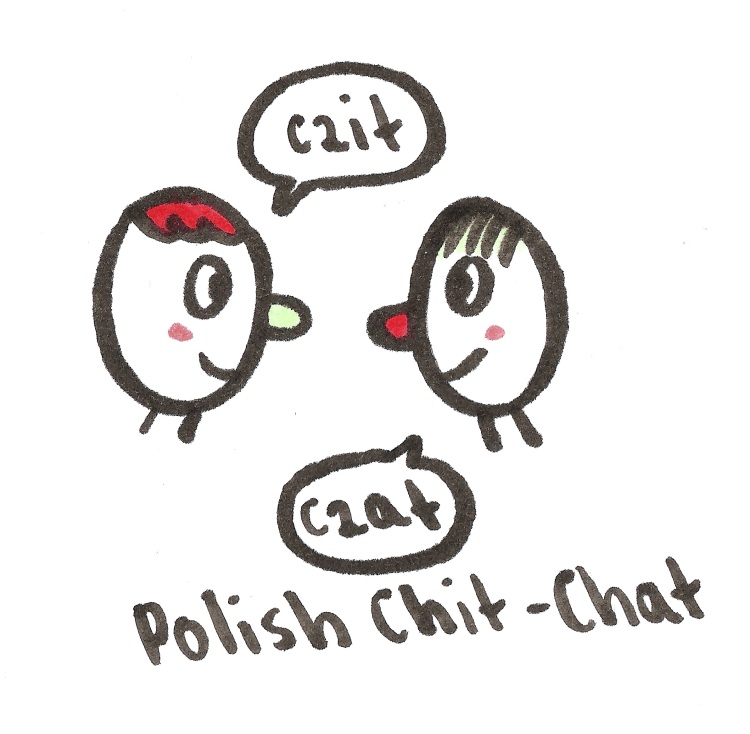
So actually, although it’s less positive, Polish chit-chat is more realistic. Everyone can relate to środa minie, tydzień ginie. Nevertheless, Americans’ positive attitude is spreading fast. Will it conquer Poland? I’m not so sure.

I used to work for an American corporation and had a lot of meetings, calls and interactions with American colleagues. One of most important emotions in the US is excitement, and during a typical meeting, Americans would say how excited they are at least once. In the US it’s important to be positive and give the impression that you’re happy, energetic and engaged.

Poles have a hard time adapting to this – I know because I ran training for groups of Poles about the differences between Polish and US corporate culture, but they didn’t go very well:

Me: You should say you’re excited at least once during a conference call with your American colleagues.

Poles: What if we’re not excited?

Me: Doesn’t matter, I don’t think the Americans are either. They just put on a positive face.

Poles: Isn’t that false?

Me: They’re trying to share positive emotions and create a good atmosphere.

Poles: But it’s hard to get excited about a new time management tool. we just don’t care that much.

In the US, there’s pressure to be positive, wear a smiling face and wish everyone a nice day. I definitely don’t feel that kind of pressure in Poland.

So Happy Friday!

The week is dead.

Have a nice weekend 😉


*George Carlin https://www.youtube.com/watch?v=xJZ6ixiVgCs