Brzechwa Blues

If there’s one thing that a learner of Polish has to eventually confront, it’s the influence of the poet Jan Brzechwa on the Polish language.

I remember being in a room full of Poles and asking what the word leń (lazy bones) meant in English. In response, one woman answered by saying Na tapczanie… and immediately three other Poles joined in and said …siedzi leń. Nic nie robi cały dzień. They were all smiling and laughing and looked at me as if they expected me to understand what was going on. I didn’t. All I knew was that I asked for the meaning of a word in Polish, and it triggered a communal recital of a poem.

And this kind of thing happens a lot. One simple word or question is enough to suddenly transport a group of Poles back into the world of Brzechwa, where they recite poems full of impulsive animals, talking vegetables and the various problems of birds. I am constantly amazed how Poles not only know his work, but have learned it by heart.

I started to wonder if that’s how children learn Polish. In Scotland where I come from, we start school at the age of 5. When I discovered that Poles don’t start school until they are 7, I was shocked and couldn’t understand what kids do with all the free time. Now I know. They spend the years from ages 3 to 7 intensively memorizing Brzechwa poems!

And what impact does this have on foreigners learning Polish? It makes the task a lot harder! You see, Brzechwa was so creative with the Polish language that he made it more complex and idiomatic. And because his poetry is on the tips of their tongues, Poles often respond in idioms or verse rather than in simple sentences. During my time in Poland, I’ve heard the following lines used instead of normal speech:

  • A to feler, westchnął seler
  • Co, kapusta?! Głowa pusta?!
  • Czy ta kwoka, proszę pana, była dobrze wychowana?
  • Jak pan może, panie pomidorze?!
  • Wybiera się sójka za morze, ale wybrać się nie może

Not knowing much about the intelligence of cabbages, the migration habits of jays, or the social skills of hens, I was lost. And even after these expressions were explained and translated, not having read Brzechwa’s poetry, I just couldn’t get a proper feel for them.

birds1

I don’t know whether Brzechwa invented all these idioms himself or just played with them, but he definitely seems to be responsible for their popularity. Indeed, it’s the opening line from his poem Chrząszcz that has set the bar for the difficulty of pronouncing Polish. As I’ve written elsewhere, this sentence is used as a mocking test of a foreigner’s doomed attempt to speak the Polish language.

When these idioms arise, I call it a ‘Brzechwa Moment’. These are times when Polish enters this weird poetic world, and sometimes, it’s not even a Brzechwa poem that causes the trouble. One time, I wanted to point out to a colleague that the weekend was almost upon us:

Me: Jutro sobota

Pole: …imieniny kota.

Me: Słucham?

Pole: Kot się ubiera, idzie do fryzjera

Me: Jesteś okej?

I knew it had been a long, tiring week, but when my colleague started talking about her cat’s name day and its plans to go to the hairdresser, I started to worry that she might need more than two days off!

Eventually I came to the conclusion that it wasn’t enough to learn vocabulary and grammar. If I wanted to communicate fluently in Polish, then I just had to memorize some Brzechwa. So I went shopping for a book of his poems. I was looking for something targeted towards Polish language learners – perhaps titled Wiersze dla obcokrajowców, którzy chcą uczyć się języka polskiego z poezją Jana Brzechwy, bo nie ma innego wyjścia (Poems for foreigners who want to learn Polish from the poetry of Jan Brzechwa because there’s no alternative) – but there seems to be a gap in the market since I couldn’t find such an edition.

So I bought a regular book for Polish children and started by learning the poem about the beetle in Szczebrzeszyn. As well as picking up some crucial Polish vocabulary – gąszcz (thicket), gaje (grove) and brzęczeć (buzz), I also learned that a wół is an ox and that they are easily tricked by beetles. While the rhymes are a great memory aid, the problem with learning from Brzechwa poems is that you can’t use little shortcuts like guessing the meanings of the words from context. For instance, take Kaczka Dziwaczka:

z apteki poszła do praczki

kupować pocztowe znaczki

(from the chemists she went to a washerwoman to buy some stamps)

Everything in a Brzechwa poem is unexpected, illogical and absurd, so you need to double check every word. And it’s embarrassing knowing that every five year old child in Poland understands the sentence a niech tę kaczkę gęś kopnie!, but I can’t work out whether it’s the duck is kicking the goose or the other way around.

When I moved on to a poem called Na Straganie, in which the vegetables in a market stall have a conversation about their various problems including lying too long on the stall or who would be the best marriage partner for a beetroot, I started to wonder whether, as well as shaping the language, Brzechwa also shapes how Poles think? After reading that poem, I empathize more with the vegetables when I’m waiting in a queue at a stall. How long have the chives been forced to sit here? How are the turnips feeling today? Is the cabbage right to prophesize that they will all end up in soup?

So I’m making progress, but it’s a long, slow road. I’m starting to fear that not having had those childhood years of intensive memorizing is too much of a handicap. In the end, I may have to accept speaking Polish without the ability to join the group recitals of Brzechwa poems.

I’ll be able to communicate in Polish, but only like the sea creatures in the poem Ryby, Żaby i Raki.

Like the ryby, it will be na niby,

and like the żaby, only be aby-aby,

and like the rak, my Polish usage will always be byle jak.
Chasing Rainbows

What colour is the Polish language?

It seems like a bizarre question, right? But actually many people have subjective experiences in which their senses overlap. It’s called synesthesia and often involves perceiving numbers, words or sounds as colours. My wife, for instance, colours the days of the week – Tuesday is dark grey, Thursday is green and Sunday is yellow.

So if the Polish language has a colour, what is it?

Blue?

There’s a Polish idiom myśleć o niebieskich migdałach (literally, to think of blue almonds) which means ‘to daydream’. Why blue almonds? It’s actually a good choice because blue food only exists in your imagination. Blueberries are purple, blue cheese is only blue because it’s turned bad, and as for smurf-flavoured ice cream, well that comes straight from a dye factory. So thinking of a blue-coloured food is a perfect metaphor for daydreaming.

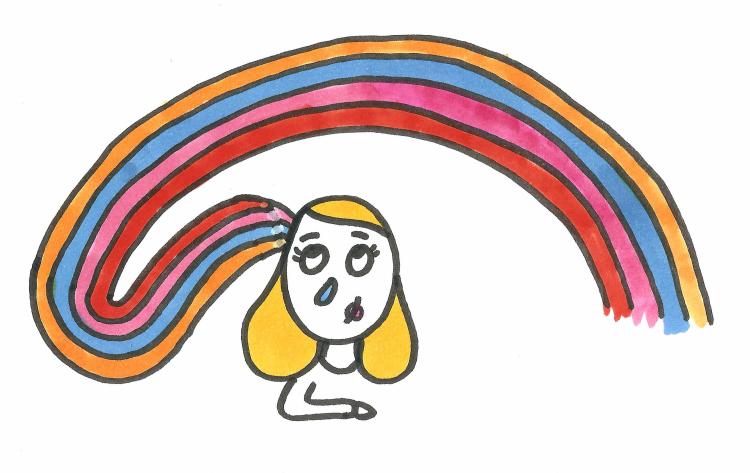
And thinking of blue almonds is also a good metaphor for a foreigner trying to master Polish. Sometimes I daydream about being able to speak the language fluently, reeling off perfectly-formed sentences like a native-speaker, understanding all of its grammatical complexities, and being able to spice up my utterances with idioms, street slang or regional dialect. Yet, deep down I know this is just chasing rainbows. At the end of the day, the Polish language is just a huge blue almond and it’s a hard nut to crack.

Gold?

Perhaps Polish is a golden language? Złoty in Polish is used in expressions like złoty interes (lucrative deal) and obiecywać złote góry (promise wonders). So perhaps the real question should be, does learning Polish offer you the chance to get rich? Not really. While many people learn English for economic reasons, I don’t think learning Polish is a złoty interes. So, no Polish isn’t a golden language.

Grey?

If you asked a British person (older than 30) to say which colour best describes Poland, they would probably answer: grey. In Cold War films and books, communist countries were portrayed as grey and bleak, and this image has stuck. So when such people happen to visit Poland, especially in the summer, they’re surprised to discover so much colour.

In keeping with its dull shade, the colour grey in the Polish language is used to describe a shady place or person: szara strefa (grey area) is place of uncertainty, while robić kogoś na szaro (lit. turn someone grey) means to swindle someone, and a szara eminencja (grey eminence) is a mysterious figure in the background who pulls the strings.

So is Polish grey? Well, it’s definitely a szara strefa, where the rules are as murky as a Polish winter, and I frequently feel swindled when I try to learn ten new words, but only remember two. And when I try to pronounce certain Polish words, I do feel as if there is a szara eminencja behind me, pulling my tongue in the wrong direction!

White & Red?

Colours were one of the first group of words I tried to learn in Polish, and I distinctly remember having a real moment of language shock when I first saw the Polish word for the red. I was expecting a word beginning with the letter ‘r’ just like words for red in other European languages – rouge, rot, rosso, rojo… in Polish it will probably be ‘rusz’ or ‘rzot’, I thought. But no, it’s czerwony, and it was then that I realised that learning a Slavic language was going to be tougher than I thought.

Since the national flag of Poland is white and red, you could easily assume these two colours would be very prevalent in the Polish language too.

In English the colour white is associated with purity and innocence. A white lie is told for a good reason, and if you’re whiter than white, then a white knight might come to rescue you. Conversely in Polish, the colour white seems to be associated with madness. While białe szaleństwo (white craziness) only refers to winter sports, the expression dostać białej gorączki (lit. get a white fever) means to go into a furious rage, something that in English, we express as red: to see red mist.

But the madness doesn’t end there. In English, when someone drinks do białego rana (until dawn) and has hallucinations when sobering up, they see pink elephants. I was amused to discover that the equivalent in Polish is widzieć białe myszki (see white mice). Now, white mice aren’t that exotic – you’re much more likely to see a white mouse than a pink elephant. And this made me wonder whether the hallucinations of Polish drunks aren’t as psychedelic as those in the English speaking world. Perhaps it’s a result of the purity of the vodka?

So there are certainly plenty of white idioms in Polish. What about red?

Curiously, there’s hardly any red idioms in the Polish language at all. Indeed, any that I came across seemed to be translations of foreign idioms (e.g. dostać czerwoną kart, czerwone światło) rather than original Polish ones. Why, despite Poland having a rather bloody history, does the Polish language ignore the colour red?

An armchair psychologist might suspect there’s something going on here. Why does the Polish language focus on white half of the flag? Why are there no red idioms? And why, when red is suppressed, do most of white idioms suggest craziness?

rainbow1

Green?

Then, perhaps Polish is a green language? The colour green is associated with youth and inexperience as the expression zielony jak szczypiorek na wiosnę (as green as chives in spring) poetically describes. Yet, to me, Polish feels an old language, more like a gnarly old hedge that’s full of thorns and practically impenetrable.

However, I did experience some greenness early on in the process of learning Polish. After getting bored of repeating nie wiem so often, I switched to the response nie mam zielonego pojęcia (lit. I don’t have a green concept/idea) when asked difficult questions. Even though I didn’t know the answer to the question, by expressing this fact idiomatically, it felt like I was making progress.

And why is it that a lack of green ideas signifies not knowing? I’ve often wondered whether Poles, when searching for information, go through a quick checklist in their heads. Red ideas? Check. Blue ideas? Yes, lots of those. Orange ideas? Yep. Green ideas?… green ideas? I’ve got no green ideas!… I don’t know anything about this!

So what can I conclude?

I know three languages – English, German and Polish. For me, English is bluish-grey, German is green, what about Polish?

I’m pretty sure it’s not red or gold, but it could be grey, white or blue.

But, at the end of the day, all I can really say is nie mam czerwonego pojęcia, nie mam niebieskiego, żółtego ani pomarańczowego pojęcia. I na pewno nie mam pojęcia zielonego!

Bullet Points

In Polish, złoczyńca means villain, złowrogi means sinister, so when I first came across the word złożony, I assumed it meant ‘evil wife’. As well as being surprised that Polish had a word for this, I also wondered whether there was a word for evil husband too – złomąż perhaps?

As it turned out, złożony doesn’t describe an evil wife at all, but actually means ‘complex’. Although I came across it by accident, I was surprised I hadn’t encountered it before. You see, for a foreigner, Poland can be a complex place – the language is difficult, the bureaucracy is Byzantine and it takes three days just to make good bigos. For most foreigners, solving every day problems isn’t so simple.

That said, when I heard about the blog by Katarzyna Tusk called Make Life Easier, I couldn’t help but laugh. Good luck, Kasia, I thought, making life easier is a very American ambition, and I’m not sure that Poles have the same aspiration. In fact, I actually think that Poles expect life to be complex.

I once heard about an American director who sent an email to a group of Polish developers – ‘I’ll be over in Poland next month. Please prepare a project plan to implement the new version of the software‘. The Poles got to work.

When the American arrived he was presented with a 250-page document outlining every detail of the project, its timelines, process maps and contingencies.

What’s this?‘ the American asked

It’s the project plan,’ the Poles replied proudly.

No, no, no‘ said the American. ‘I just need something short. Just the steps ABC and some deadlines. Can you prepare that for tomorrow?

The Poles worked all night and reduced the document down to most essential 50 pages and even then they had to cut out many things they considered crucial. The next day they handed the 50 pages to the American, saying ‘ we cut it down as much as could‘.

The American sighed and repeated his request. ‘No, guys. I don’t have time to go through all this. Just give me a one-page document with the key steps and completion dates. That’s all.’

The Poles were confused and returned to their desks, muttering ‘What’s this? A kindergarten?!

I can relate to that American because I had similar experiences while working as a trainer. Whenever I presented a technique or solution, experience taught me that most Poles would respond in one of three ways:

  • it can’t be that simple – some participants would dismiss the solution by pointing out that the approach was too simple and therefore insufficient.
  • what if…? – other participants would come up with hypothetical scenarios in which the technique would fail.
  • yes, but it won’t work in Poland – and finally, at least one participant would always point out that Poland is a special place where such techniques don’t work.

It happened so frequently that I began to question my own assumptions. Do Poles actually expect life to be complex? Do they trust simple solutions? If something is short and straightforward, then, to a Polish mind, does that mean it’s not an accurate reflection of reality?

In the UK and especially in the US, people love simple solutions. From 7 Habits of Highly Effective People to 10% Happier, we like books with a discrete number of ideas, straightforward categories and an ABC series of steps to reach success. There’s even a self-help book called The One Thing: The Surprisingly Simple Truth Behind Extraordinary Results which you can also buy online in a summarized format if you don’t have time to read the whole book. Yes, that’s right. Some people believe that success can be reduced to one simple truth… yet they still don’t have time to read all the details!

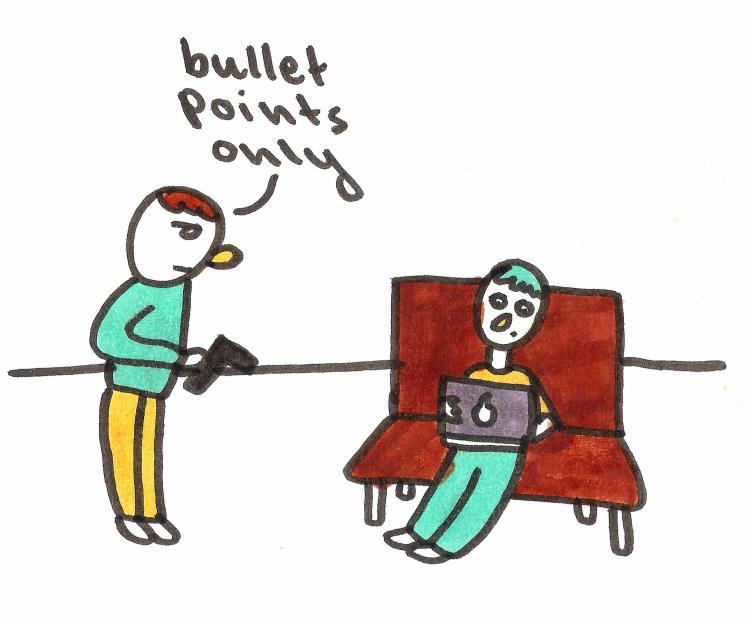
Indeed, we Anglo-Saxons hate detail so much that we invented a way to kill it – bullet points. Bullet points are a way of saying ‘just forget about all the baggage. Give me the key points. All the rest is a waste of time.’ In fact, bullet points are what’s left once you’ve shot all the unnecessary information!

bullets1

Maybe I should write a book called The One Anglo-Saxon Idea that Poles have a Problem with. To give you a summarised version (in case you don’t have time to read the whole text), it would present the hypothesis that Brits and Americans think it’s possible to apply the same solution in multiple contexts, while Poles believe that every context is different and requires a separate strategy.

And the most different, the most special context is… Polish reality… which is an expression I’ve heard countless times. Yes, but it wouldn’t work in Polish reality. Why not? Because it’s just too complex!

So, to appeal to Poles, I get the impression that the publishers would need to translate the title of Steven Covey’s book from 7 Habits of Highly Effective People to 7 Habits, 14 Problems with those Habits and 21 Exceptions to the Rules of Highly Effective People.

And finally, we come to the Polish language, where there’s nothing simpler than food – bułka z masłem, kaszka z mlekiem (easypeasy) – I get the impression that you could combine any food with another food and a Pole would understand that you’re talking about something straightforward – nie martw się, to jajko z majonezem.

However, my favourite illustration of all this is the expression prosty jak budowa cepa (as simple as the construction of a flail). It’s very ironic that the Polish expression to describe something that is uncomplicated… talks about something I’ve never seen and never used. I don’t know what a flail looks like, I don’t know how to build one, and honestly, I don’t even know what it’s used for.

So, to me, all this Polish complexity is prosty jak budowa cepa… literally!

How to Catch a Spy

In war films and novels, spies often try to learn a foreign language so perfectly that they can pretend to be a regular citizen in that country. However, despite years of intensive training, learning the minutiae of the target culture, one little slip up is enough to reveal the spy’s secret identity. For instance, in Tarantino’s film Inglorious Basterds, a British spy in Germany speaks perfect German and almost fools a member of the Gestapo. However, when ordering a round of drinks, he shows the number three by holding up three fingers rather than two fingers and one thumb. This little piece of British body language gives him away and the Germans arrest him immediately.

So I began to wonder what little aspects of Polish language and culture would a spy have to learn in order to pass him or herself off as a Pole? Alternatively, what little aspects of Polish society might be potential traps for our spy, causing him or her to slip up and reveal that they are not actually Polish?

Landing in Poland

Our spy needs to stay alert as soon as the plane approaches Poland. While he might be worried about border control, his problems start a little earlier than this. When the plane touches down safely, some Poles begin to clap. I’ve never known why they do this. Is because they are relieved that they didn’t crash, because they are so thrilled to be on Polish soil, or are they giving the pilot a round of applause for flying well? I’ve no idea, but whatever it is, to pass himself off as Polish, our spy has two choices – (1) applaud and thereby pretend to be a Pole from an older generation who doesn’t have much experience of flying, or (2) look embarrassed, thereby pretending to be a younger Pole with more flying experience. If he looks surprised, then it’s obvious that he’s not Polish.

The Napkin Test

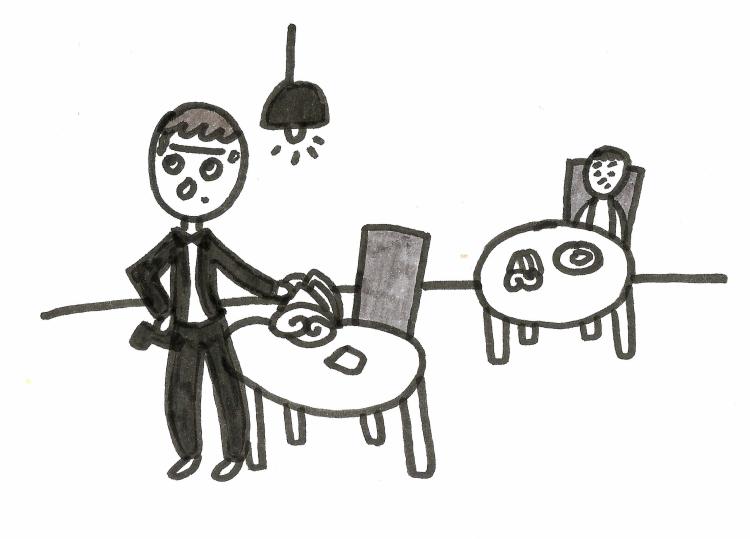
The next place where our spy needs to be alert is in a Polish milk bar. His cultural training will hopefully have taught him that a milk bar doesn’t sell milk and it’s not a bar, but it’s when he sits down that issues might arise. In Polish bars there are usually napkins on each table. These thin squares of paper are arranged in a triangular fan and held in a small stand. The challenge is to take one without pulling out the rest. I’m amazed by Poles who, without even looking, gracefully pluck out a napkin from the centre while carrying out a conversation. I’ve been in Poland for years, but I still haven’t mastered this, and have to lift out all the napkins, unfold the bundle, remove one, fold them and put them back in the stand. I can imagine the sweat on our spy’s brow as he reaches for the napkins, knowing that if he pulls the wrong one, all of them will spill out and his identity will be revealed to the entire milk bar.

bond1

Likewise, he needs to be careful with the salt and pepper pots. Unlike in the UK, where a pot with one hole contains salt and a pot with three holes contains pepper, it’s the other way around in Poland. If he ends up shaking pepper onto his chips, then he’s a dead man.

Suppressing British Impulses

It won’t be easy, but our spy will need to suppress intense British impulses during his stay in Poland. This will be especially difficult concerning tea. Firstly, he needs to break the mental association between tea and time. In Poland, you can drink tea whenever you want and there’s no specific tea time in the late afternoon when you must take a break for tea. Secondly, if he really has to add milk to his tea, then he mustn’t take offense if the waiter brings warm milk. No matter how ghastly it is to put warm milk in tea, he’ll just have to pretend to enjoy it.

Queues

No matter how much prior training he gets, it’s still going to be a challenge to queue like a Pole. The first thing he needs to know is when not to queue. If he just has a question, then he shouldn’t wait in line, but instead barge straight to the counter, interrupt whoever is being served and loudly ask his question. Politely waiting in line to ask a question is a dead giveaway that he’s a Brit.

Body language is another potential telltale sign that he’s a spy. A true Pole looks a little anxious when queuing as if someone is suddenly going to jump ahead of them. This is especially important if you’re standing in a line. Here you should constantly encroach into the personal space of the person ahead of you. If this results in physical contact, whatever you do, don’t apologise. That would be a clear signal that you’re British.

Clothing

Of course, our spy needs to get his clothes right if he’s going to blend in effectively. One thing he needs to bear in mind is the amount of clothing. If he wants to look Polish, especially in winter, then he needs to wear as least twice as many items of clothing as he would in the UK.

For Poles this attachment to multiple layers starts in childhood. One thing that did surprise me about the Polish winter was the amount of clothes Polish children are forced to wear. This is fine if it’s minus ten, but if it’s plus five degrees, do they need to be dressed like an arctic explorer? One shock that most Poles get in the UK is when they see young children wearing shorts, t-shirts and flip-flops… in winter. On the whole, this difference is harder for a Polish spy in the UK than a British one in Poland.

Public Meetings

A spy needs to meet other operatives and exchange messages in public places. What potential issues could arise? First of all, there’s time-keeping. If you agree to meet your Polish agents on a park bench, don’t give them up for dead if they are 10 minutes late. In Poland, 3 o’clock lasts from 3.00-3.15, so it’s possible to be 15 minutes late and still be on time.

The next question is what to carry with you so that you look normal. Poles buy huge quantities of flowers, so if you’re carrying a bunch of flowers, any one observing you will assume you’re on your way to someone’s house, a church or a grave. But our spy will need to be careful – Poles always buy an odd number of flowers, so if he’s carrying a dozen red roses, then they’ll be for his own grave!

Our spy should also bear in mind that Poles have a long history with clandestine and conspiratorial activity, so don’t try to outsmart them. Fortunately, for our spy, firanki (net curtains) never went out of fashion in Poland, so he can simply rent an apartment opposite some key location and do all the spying he wants from the window!

Referring to Oneself

James Bond doesn’t go undercover, he’s not that type of spy. However, his way of introducing himself would actually lend itself to being an effective agent in Poland. ‘Bond, James Bond‘ mirrors the way a Pole will often say ‘Kowalski, Jacek‘ when introducing himself in a formal situation as opposed to the British way of saying the first name followed by the last name.

Another potential pitfall when referring to yourself is not to overuse the word Ja. Hopefully, our spy has paid attention during language lessons and learned that Poles incorporate the pronoun into the verb and just say jestem or mam instead of ja jestem, ja mam etc.

Personally, I’d fail this particularly test as I’m guilty of saying ja too often. My wife laughs every time I explain away my poor Polish by saying ja-aaaaa jestem Szkotem. As well as sounding like Sean Connery when I elongate the ja-aaaaa, it gives away my foreignness both in form and content.

The Departure Gate

In the unlikely event that our spy survives all of the potential pitfalls mentioned above, there’s one last test before he can board a flight to safety.

In an airport, just before a flight is called, you can tell which passengers are Polish and which are not just by looking. How? Well, all the non-Poles will be sitting, waiting for an announcement that the plane is ready for boarding. All the Poles, however, will already be standing in a queue, waiting to board. Our spy, to avoid being caught, will need to stay alert. As soon as the first Pole decides that it’s time to board, he needs to hurry to the boarding game and join the emerging queue with the other Poles. Then, and only then, might he complete his mission successfully.